

Object Details
Artist
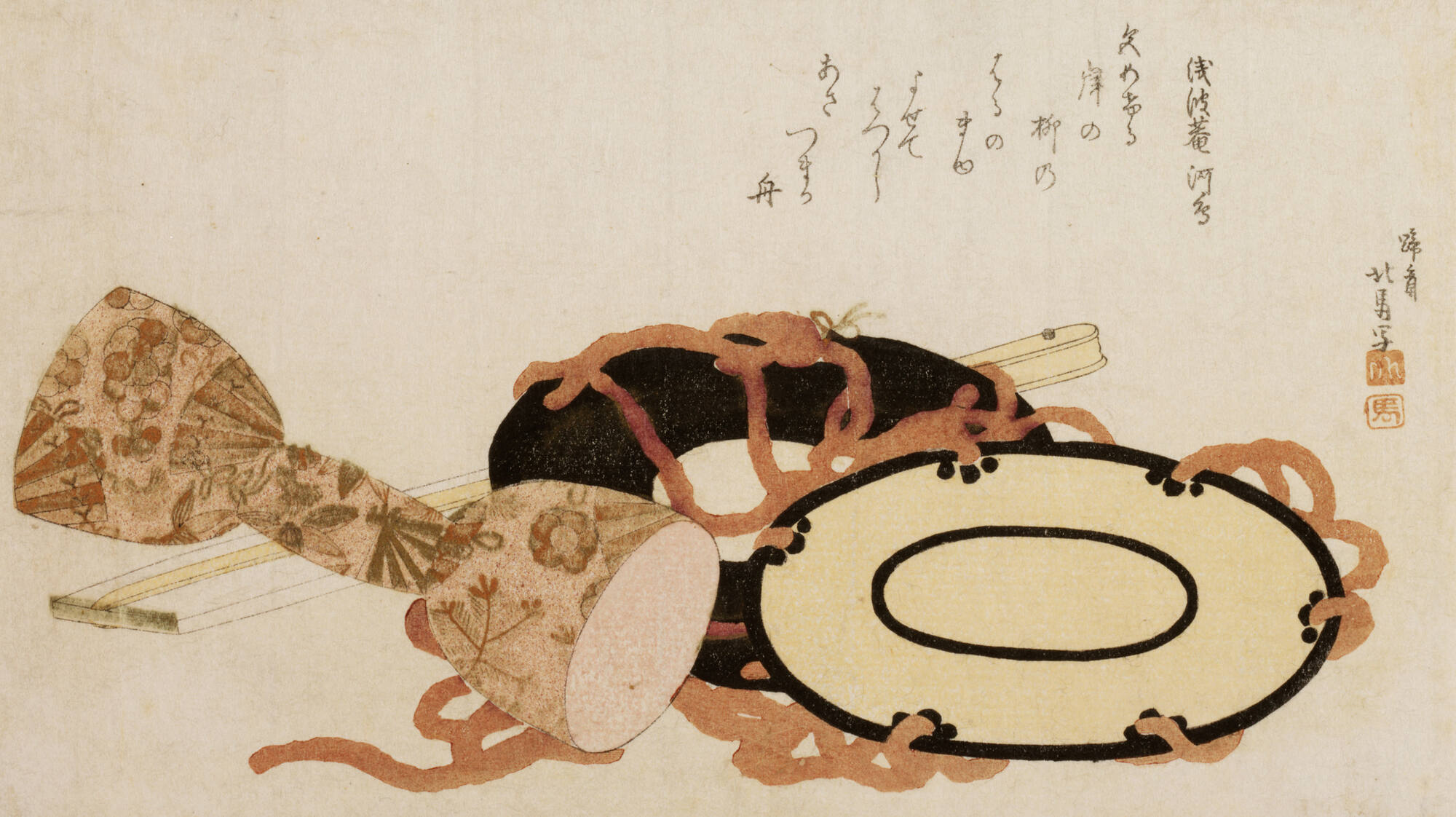
Teisai Hokuba
Date
possibly for New Year 1809
Medium
Color woodblock print
Dimensions
5 1/4 × 9 3/16 inches (13.3 × 23.3 cm)
Credit Line
Gift of Joanna Haab Schoff, Class of 1955
Object
Number
2011.017.012
Iro mekeru Coming into color Kishi no yanagi no The willows on the shore Haru no mayu With s(…)
Iro mekeru Coming into color Kishi no yanagi no The willows on the shore Haru no mayu With spring-like, arching eyebrows Yosete hazukashi Drawing close coyly Asazuma ga fune The boats of Asazuma —Sempaan KawadoriThe image and poem combine to refer to the tradition of prostitutes who plied their trade on the waters of Lake Biwa, wearing male kimono, singing and playing music like shirabyoshi dancers. This theme of the original “water-trade” prostitute became politically charged in the Tokugawa Period (1600–1868) when the independent painter Hanabusa Itcho (1652–1724) created a satirical portrait of one of the shogun’s mistresses in the guise of such a woman, for which he was exiled from Edo for over ten years. As a result, the image of the water prostitute became iconic, and Hokuba needs only hint at it here for recognition. The poem makes this connection explicit, however, by overlaying natural spring imagery with eroticism. Iro mekerucan mean to achieve a fullness of color in the nature cycle, or to be amorous, while “willow” refers to a slender, young beauty. Mayucan means “eye-brow,” or the flap of a courtier’s headgear (eboshi) such as the shirabyoshi dancers wore. Asazuma (literally “morning wife”) was the name of a harbor on Lake Biwa, not far from Kyoto, where the boat-riding prostitutes plied their daytime trade. The image reinforces this with the shirabyoshi’s colorful drum and fan, the very dishevelment of which seems to have erotic overtones.