




Katsukawa Shuntei-Ga
(Japanese, 1770–1820)
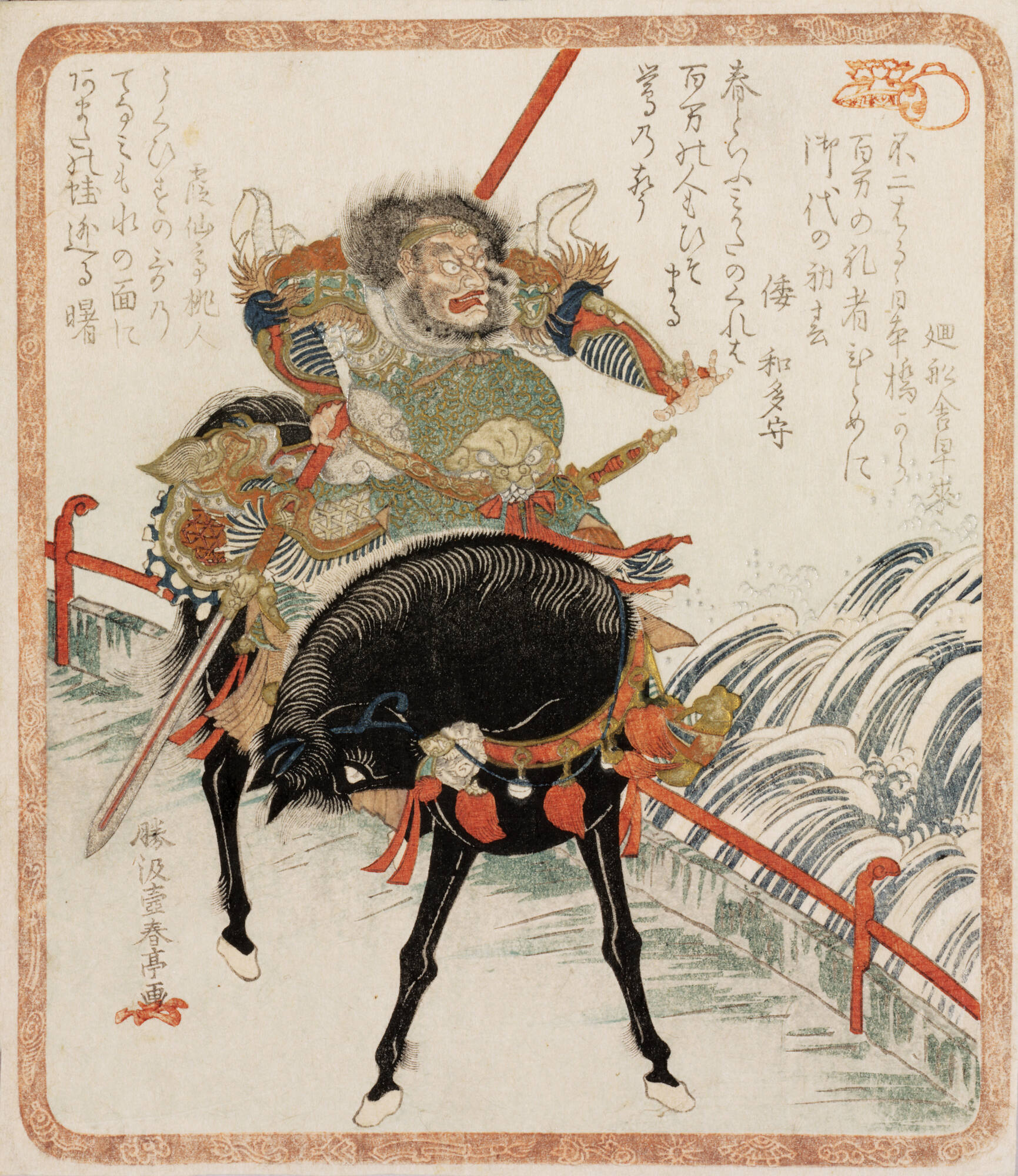
General Zhang Fei Guarding the Changbanqiao Bridge
Object Details
Artist
Katsukawa Shuntei-Ga
Date
commissioned for New Year 1822, Year of the Horse
Medium
Color woodblock print
Dimensions
8 3/16 × 7 1/16 inches (20.8 × 17.9 cm)
Credit Line
Gift of Joanna Haab Schoff, Class of 1955
Object
Number
2011.017.028
Commissioned by the Flowery Hat Circle (Hanagasa-ren) of the Drum Group (Taiko-gawa) for New Year 18(…)
Commissioned by the Flowery Hat Circle (Hanagasa-ren) of the Drum Group (Taiko-gawa) for New Year 1822, Year of the Horse Fuji haruru Nihonbashi kara Hyakuman no Reisha hitome ni Miyo no hatsuharu With Mt. Fuji seen clear From Nihonbashi Bridge The myriad celebrants crossing Look with a single glance At the beginning of spring in the realm —Kaisensha Hayaki Haru to iu Mikata no kureba Hyakuman no Hito mo hisomaru Uguisu no koe Now that the ally Called spring has come A million people Are silenced By the voice of the warbler —Yamato no Watamori Uguisu no Uta no tenami mo Mizu no omo ni Amata no kawazu Niguru akebono The warbler’s skill At singing is such That at the dawn A multitude of frogs Flee from the face of the water —Kasentei MomohitoWith a fierce scowl, General Zhang Fei (Cho-hi), mounted on a black charger, single-handedly defends the Changban Bridge with his enormous spear. In the Romance of the Three Kingdoms (Sangokushi), Cho-hi was one of the three legendary heroes (along with Kan’u, see no. ??) that took an oath of fraternity in a Peach Garden in the opening chapter of the narrative, devoting themselves to the restoration of order in the land. The most unruly of these sworn brothers, Cho-hi proved himself by driving off a million troops of their mortal enemy Caocao, with his stand at the Changban Bridge. The “million” (hyakuman) described in Sangokushi figures in each of the first two poems, while the third mentions only a general “multitude” of similarly fleeing frogs. Other hints at the identity of Cho-hi include the reference to a bridge in the first poem, and the line haru to iu mikata, “an ally called spring,” but through the alternate Japanese reading of the character Zhang (haru), “an ally by the name of Zhang.” The first poem also puns, somewhat irreverently, with the phrase miyo, meaning the imperial reign, but homophonous with “look,” while also fitting in another reference to haru/Zhang. Since Fuji is here written with characters meaning “not two,” an embedded “the incomparable Zhang” (and also “incomparable spring”) could also be read into this first line. The third poem, perhaps punning on the literal reading of Zhang Fei’s name, “extended jump,” mentions frogs, who traditionally compete with the warbler in singing ability.
Discover More

Good Advice, from Thirty-five Impressive Years: The Printmakers, Inc., 35th Anniversary Portfolio
Kelly O’Brien, Printmakers, Inc.
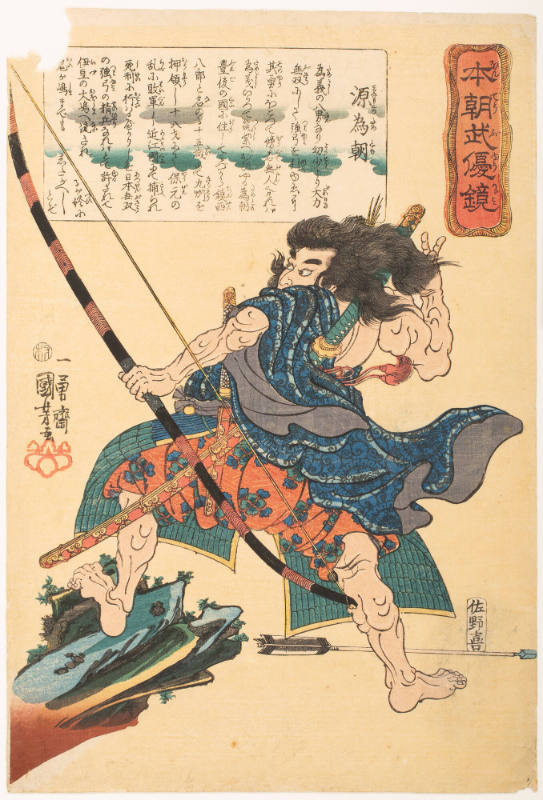
The Warrior Minamoto no Tametono Shooting Arrows with a Giant Bow, from the series Mirror of our Country’s Military Elegance
Utagawa Kuniyoshi, Sano-yu Ihei