





Object Details
Culture
Korean
Medium
Mishima ware: ceramic with celadon green glaze
Dimensions
1 3/4 × 4 1/4 inches (4.4 × 10.8 cm)
Credit Line
Gift of Miss. Esther Faulhaber
Object
Number
73.036.002
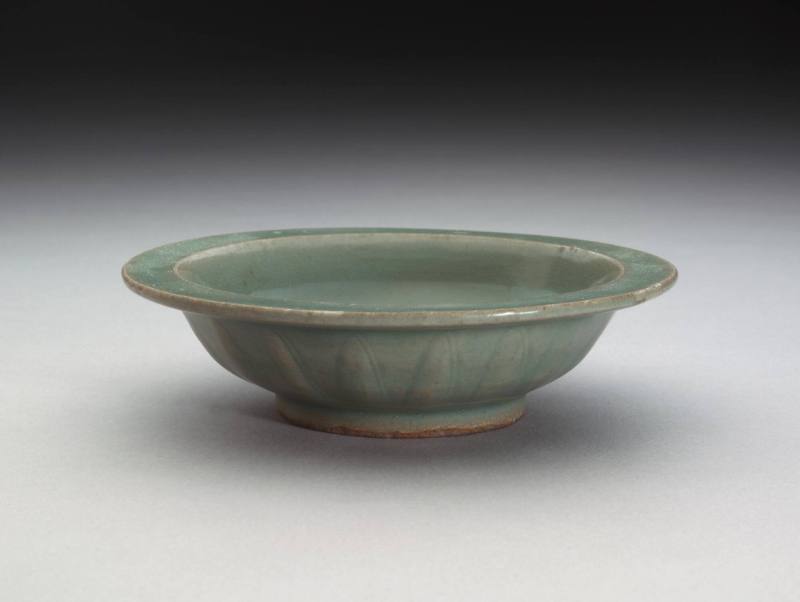
BRIEF DESCRIPTIONThis is a small ceramic dish with inlaid designs of chrysanthemums around the exter(…)
BRIEF DESCRIPTIONThis is a small ceramic dish with inlaid designs of chrysanthemums around the exterior.WHERE WAS IT MADE?This dish was made in Korea during the Goryeo period.HOW WAS IT MADE?A fired clay mold was likely used to make this dish. A rolled out slab of clay would have been pressed over the mold, then trimmed along the edges. The decorations along the outside of the vessel are the result of a technique developed and perfected by Goryeo potters called sanggam, and is a unique feature of Goryeo ceramic wares. To achieve the black and white designs, first potters incised a design into the leather-hard clay. Into these depressions they applied red or white slip. Slip is a mixture of water and clay, and can be made in a variety of different colors, depending on the type of clay used. The vessel was fired in an oxidizing atmosphere to fuse the clay of the slip with the clay of the vessel. Once cool, a final glaze was applied to the entire vessel, and it was fired one more time, this time in a reducing atmosphere. This turned the red slip black, and left the white slip white.The green glaze on this dish is known in the west as celadon. The glaze contains iron oxides, which turn green when the vessel is fired in a reducing atmosphere. This technique came to Korea from China, along with a new kind of kiln construction. Goryeo ceramics were fired in long kilns (up to 60 feet long and four feet wide) built into the hillsides so that they climbed upwards. The insides of the kilns were lined with clay, and wood was used as the primary fuel for the fire.The kilns were supervised by government officials, and most of the ceramics were made for members of the government and other aristocratic families. Potters did not enjoy high social status, nor were they regarded as artists in the way that painters were.HOW WAS IT USED?This dish was likely used to serve food.WHY DOES IT LOOK LIKE THIS?This dish is decorated with chrysanthemum flowers, a common motif in Goryeo ceramics. The chrysanthemum was popular in Korea and in China, where it was one of four plants known as the “Four Gentleman,” or the “Four Gracious Plants.” Each flower represented an attribute of a Confucian scholar. The chrysanthemum represents constancy because it continues blooming in late fall, despite the frost. It is also a symbol of the fall season in Korean, Chinese, and Japanese art.The octagonal shape of the dish was a common type as early as the 12th century, and such dishes have been excavated from tombs, where they were interred with other items to provide for the deceased in the afterlife.To see other Goryeo octagonal dishes with chrysanthemum designs in the Johnson Museum’s collection, search for object numbers 73.036.001 and 92.031.001 in the keyword search box.