

Object Details
Artist
Erich Heckel
Date
1917
Medium
Woodcut on wove paper
Dimensions
Image: 14 1/4 x 11 5/8 inches (36.2 x 29.5 cm)
Sheet: 28 x 21 7/8 inches (71.1 x 55.6 cm)
Credit Line
Acquired through the Museum Purchase Fund
Object
Number
69.139
Heckel was classified as unfit for active service during the First World War, but volunteered to ser(…)
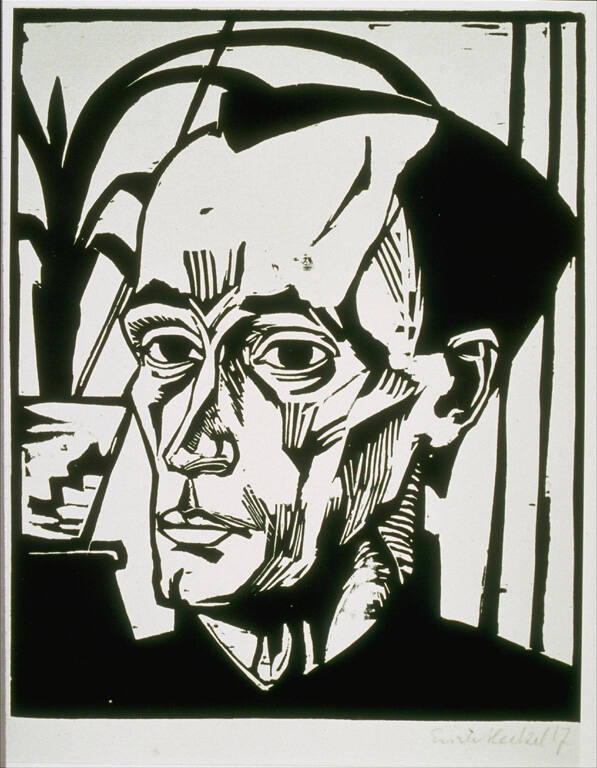
Heckel was classified as unfit for active service during the First World War, but volunteered to serve in an ambulance unit and was appointed to nurse the wounded in Flanders in 1915. Here he met Max Beckmann and made friends with the Belgian symbolist artist James Ensor. Heckel and Beckmann were—along with other artists—under the command of art historian Walter Kaesbach, who so detailed their duties that every other day was left free for artistic work. In this self-portrait, Heckel delineates the traumas of the war on his own face, gaunt and saddened by his experiences on the Western Front. There is a physical and spiritual weariness here that was both personal and national in origin. The use of woodcut, with its stark slashing lines, emphasizes this feeling of despair.After the war, Heckel returned to Berlin. Thereafter, his art became more melancholic but also more populist, with pastel colors replacing the more garish tones found in his previous work.In 1937 Heckel’s work was declared “degenerate” by Hitler’s regime and by 1944 all his woodblocks and printing plates had been destroyed. He spent his post-World War II years living near Lake Constance and teaching at the Karlsruhe Academy, until 1955. (“‘The War to End All Wars’: Artists and World War I,” curated by Nancy E. Green and presented at the Johnson Museum, January 21-June 11, 2017)Heckel was one of four architecture students who founded Die Brücke in Dresden in 1905. Avid printmakers, they used many media though woodcut, a traditional German technique, was favored. Influenced by African, Oceanic, and pre-Columbian sources, they used bright colors and crudely executed compositions to make their statements. In 1911 Heckel moved to Berlin and two years later, Die Brücke was dissolved.Declared unfit for active duty during World War I, Heckel nonetheless volunteered as an ambulance driver and served in Belgium. Many of his images show the wounded and in this self-portrait, his gaunt face and staring eyes reflect the devastation and brutality that he has witnessed. Yet he slightly softens the effect by depicting a flourishing plant in the background, perhaps an indication of a faint but clear hope for the future. (“Imprint/ In Print,” curated by Nancy E. Green with assistance from Christian Waibel ’17 and presented at the Johnson Museum August 8 – December 20, 2015)