

Object Details
Artist
Rosalind Fox Solomon
Date
1981 (negative)
Medium
Gelatin silver print
Dimensions
Image (including border): 15 1/4 × 15 1/4 inches (38.7 × 38.7 cm)
Sheet: 19 7/8 × 16 inches (50.5 × 40.6 cm)
Credit Line
Gift of Frank Canale, Class of 1969, and Mary Jane Canale
Object
Number
2019.002.019
In this distinct and poignant image taken in Kumartuli, the traditional potters’ quarter in Calcut(…)
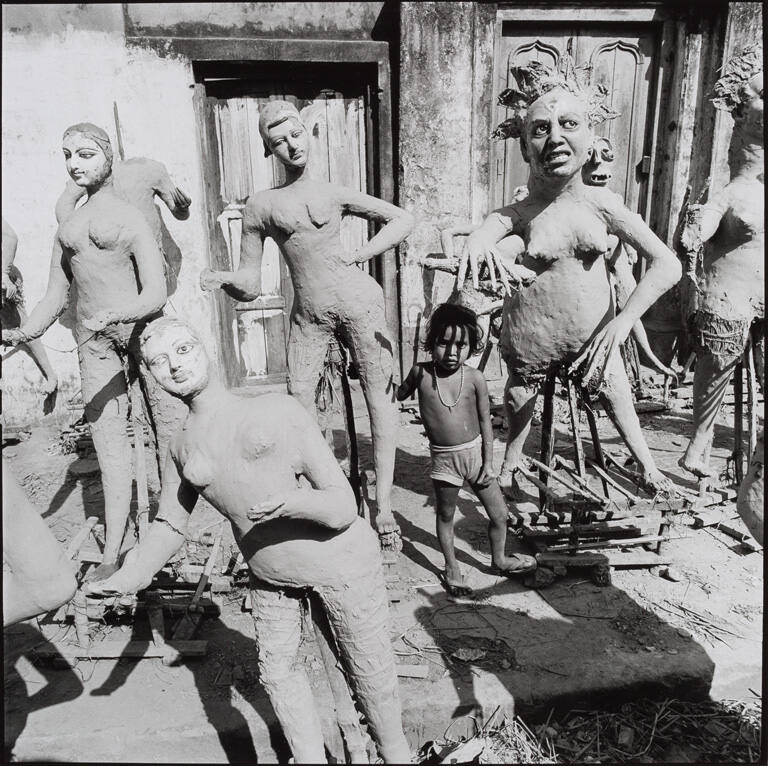
In this distinct and poignant image taken in Kumartuli, the traditional potters’ quarter in Calcutta (now Kolkata), a clay- and dust-smudged potter’s child looks up at the camera as she holds onto the leg of a Durga idol, while the eerie shadow of the scrawny, elongated fingers of another Kali figurine falls on her face. While the labor is manifest in the crowd of Durga iterations affixed on crates and lined up to dry in the sun, with bits of straw strewn or exposed in their bodies, we do not see the artisans themselves. The idols would be later touched up, painted, and dressed in splendor and finery to be sent to the annual Durga Pujas festival across the city, celebrated by Bengali Hindus to mark the Goddess’ victory over the demon Mahishashura.
The mrtishilpis (clay modelers) use clay from the Hooghly River for their work, and Kumartuli was part of the occupation-based allotment drive by the British East India Company. They were not considered artists because of colonial art education which elevated fine art. While some ventured into film set design, this image reveals the low socioeconomic status of the artisans. Today, Durga Puja is marked by elaborate-themed pandals (pavilions), with some artists attaining middle-class designer status, while the rest remain on the margins, thereby opening new hierarchies and grounds for contestations.
—Ayesha Matthan, PhD candidate