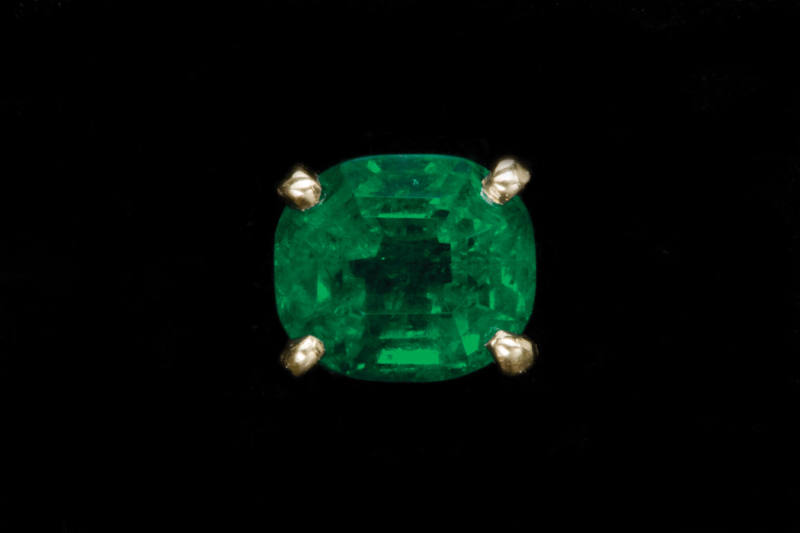





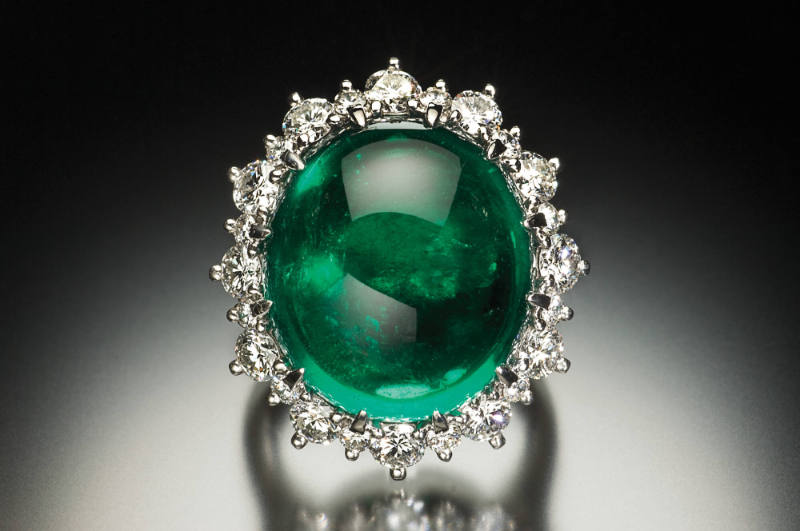
Emerald and Diamond Ring/Pendant

Object Details
Date
collected 1992
Medium
19.41 carats
Dimensions
17.70 × 15.80 × 10.00 mm
Credit Line
The Edward Arthur Metzger Gemstone Collection
Object
Number
EAM 034
Pliny ranks the emerald (smaragdus) third amongst gemstones after diamonds and pearls, not least bec(…)
Pliny ranks the emerald (smaragdus) third amongst gemstones after diamonds and pearls, not least because “there is nothing at all that is more intensely green” (37.63). Emeralds have such special qualities, he claims, that “mankind has decreed that they must be preserved in their natural state and has forbidden them to be engraved” (37.64). Despite archaeological evidence to the contrary, Pliny is keen here, as elsewhere, to protect the integrity of matter, celebrating the color, transparency, and exotic geographical origins of gems over their status as luxuries. Nevertheless, Pliny is especially interested in the effects of emeralds upon vision, claiming that they soothe the strained eyes of gem-cutters and that the emperor Nero even watched gladiatorial combats “through a smaragdus,” possibly to reduce the glare of the arena (37.64). Most strikingly, he tells us of a marble statue of a lion on the island of Cyprus with emerald eyes; these blazed so brightly above the sea that they frightened off the local tuna until they were replaced by local fishermen.
(Verity J. Platt, “Wonder and Wakefulness: The Nature of Pliny the Elder,” exhibition organized by the Herbert F. Johnson Museum of Art, curated by Andrew C. Weislogel and Verity J. Platt, presented at the Johnson Museum January 21–June 11, 2023)