


Ciro Ferri
(Italian, 1634–1689)
Saints Augustine, Jerome, Bartholomew, and an unidentified saint

Object Details
Artist
Ciro Ferri
Date
after 1670
Medium
Pen and brown wash over black chalk, squared in black chalk
Dimensions
Sheet: 15 3/4 × 17 1/4 inches (40 × 43.8 cm)
Mount: 16 1/8 × 18 5/8 inches (41 × 47.3 cm)
Credit Line
Acquired through the generosity of Seymour R. Askin, Jr., Class of 1947, and Helen-Mae Askin, and Diane A. Nixon
Object
Number
2013.023
Ciro Ferri was active during the massive transformation of Rome under a succession of powerful popes(…)
Ciro Ferri was active during the massive transformation of Rome under a succession of powerful popes into the architectural version of the city we recognize today. This study reveals part of Ferri’s vision for the dome of the recently reconstructed Pamphili family church of Sant’Agnese in Agone, in Piazza Navona. The 1670 commission requested an allegory of the church’s namesake, St. Agnes, receiving her martyr’s crown from the Virgin Mary, surrounded by dozens of biblical and church personages.
The project was ultimately completed by a pupil after Ferri’s death and as such records the artist’s invention, energy, and sensitivity arguably better than the finished product. According to Nicholas Turner, few surviving studies for this project match this drawing’s impressive size, or feature its squaring for enlargement to make the leap to full scale. Ferri depicts a heroic grouping of St. Augustine of Hippo, in bishop’s vestments, St. Jerome, depicted with a lion, and St. Bartholomew, with the knife indicating his martyrdom by flaying. Augustine and Jerome, friends and pillars of the church, seem deep in conversation, perhaps over Jerome’s Latin translation of the Bible, over which they corresponded.
The large oval stamp at lower left is that of the Société Philotechnique of Lorient, founded in this Breton port town in 1832. This is the first known occurrence of the mark.
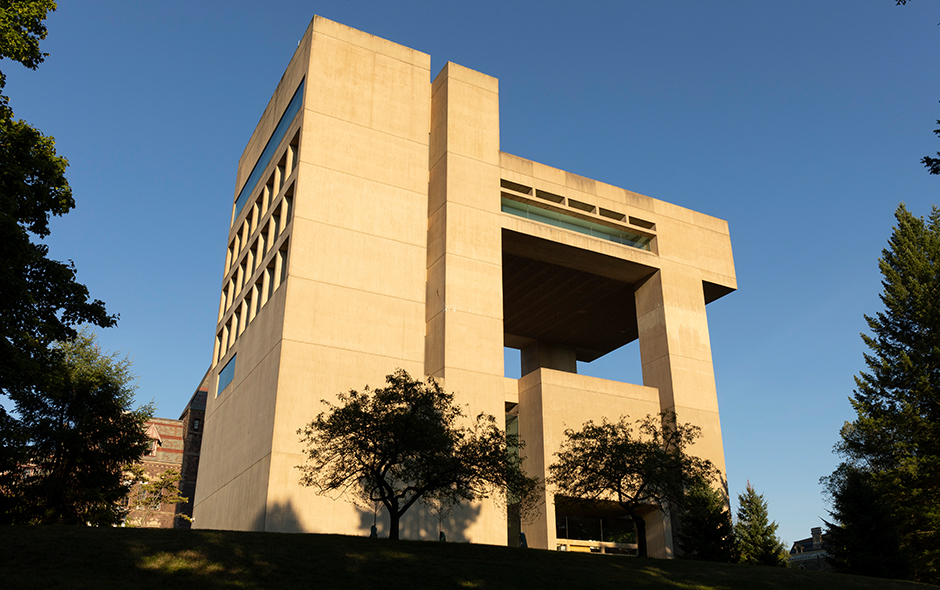
This drawing strengthens ties with Cornell’s Department of Architecture, with its long-established Rome program, enabling access to a key document for those studying Roman art and urbanism.
(“FIGURE/STUDY: Drawings from the Herbert F. Johnson Museum of Art,” text by Andrew C. Weislogel and presented at Carlton Hobbs, LLC January 25-February 2, 2019)