

Utagawa Toyokuni II
(Japanese, 1802 (?) – 1835)
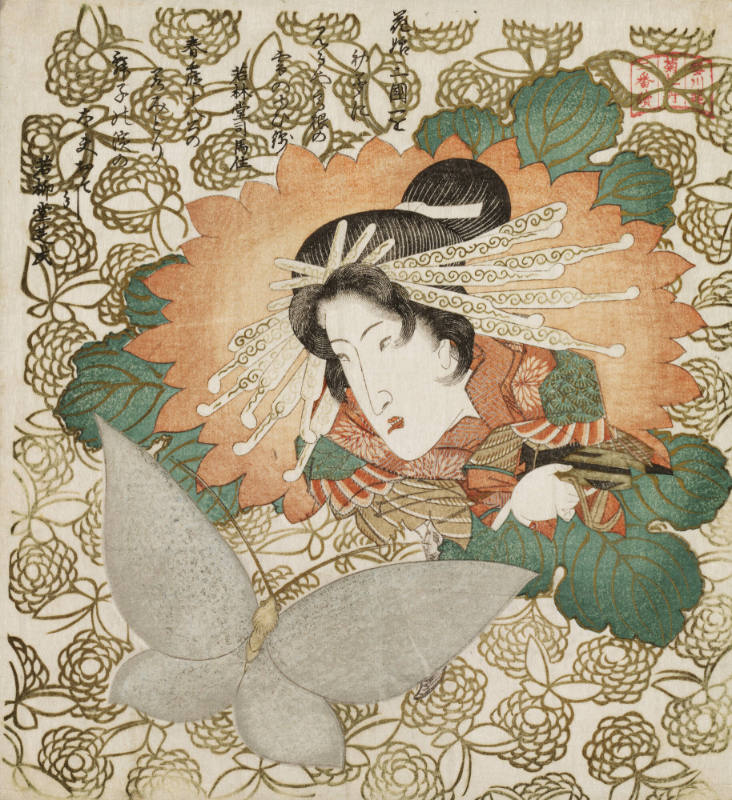
Peonies and Chrysanthemums for the Sakuragawa Circle (Sakuragawa-ren kiku botan)

Object Details
Artist
Utagawa Toyokuni II
Date
commissioned for a New Year, ca. 1828
Medium
Two color woodblock prints
Dimensions
Part a: 8 3/16 × 7 1/2 inches (20.8 × 19.1 cm)
Part b: 8 1/8 × 7 3/8 inches (20.6 × 18.7 cm)
Credit Line
Gift of Joanna Haab Schoff, Class of 1955
Object
Number
2011.017.034 a,b
Left sheet:Hana musume Sangoku ichi wo Hatsuyume ni Miruya takane no Yuki no yuiwata This flowerymai(…)
Left sheet:Hana musume Sangoku ichi wo Hatsuyume ni Miruya takane no Yuki no yuiwata This flowerymaiden The best in the three countries Snow on the high peak of her Cotton hair ribbons Seen in the year’s first dream —Jakurindo ¯Shibazumi Harugasumi Ju ¯hachiko ¯no Waka midori Maikono hama no Dayu ¯osobiki In the spring mist The fresh green of The “eighteen lord”pine The courtesan from MaikoBay Is freed at last —Jakuryu ¯do ¯Shibanari Right sheet:Ochitsuita Mono kumoame ni Nuregami no Yanagi wa ume to Narabu sekitori Calm things Washed in the rain clouds The willow,with its hair wet Stands alongside the plum As its mighty equal in rank —Yanagi no Itomaru Nodoka naru Haru no ni cho ¯no Maigami ya Sumire tambo no Hanazumo ¯nimo In the peaceful fields of Springtime, the butterfly’s Forelocks In a paddy with violets The flowersare doing sumo —Sakuragawa Jihinari This diptych depicts Ichikawa Danju-ro-VII as the sumo wrestler Nuregami Cho-goro- and Segawa Kikunojo- as the courtesan Azuma from the popular play Futatsu Cho ¯cho ¯ Kuruwa Nikki (Two Butterflies: A Diary of the Pleasure Quarters), first staged as a puppet play in 1749, and extremely popular in later kabuki, with a number of performances in the 1820s. The play seems to have been based on an actual event, in which a sumo wrestler killed a samurai in a fight, and the title on a pun on the names of the two wrestlers in the play, both of which include cho ¯(homophonous with “butterfly”). The complex plot has Cho-goro -attempting to help ransom Azuma for his patron, Yogoro-, against his rival, who is the patron of another sumo wrestler, Cho-kichi. Ultimately, in a fight between the patrons and their henchmen, Cho-goro- kills four men, and must flee Edo, but is spared prosecution by some surprising plot twists. This image shows the wrestler, in the outline of a giant peony, an alternative crest (kaemon) for Danju-ro-, with the silhouette of a bat overhead. He looks sternly, mouth downturned, across to Azuma in the right sheet, who appears in an inset shaped like a chrysanthemum (kiku), the crest of Kikunojo-, with a name in Harima, famed for its seaside pines, but maiko (“dancing girl”) also refers to an apprentice geisha. Azuma, by contrast, was a matsu no dayu ¯ (“Pine Lady”), the highest rank of courtesan, as the pointed use of dayu ¯ in the final line emphasizes, lending further connotations to nebiki. The pine itself is referred to here obliquely, by describing the character used to write it, which can be parsed as “eighteen lords.” The poems on the left sheet play with the name of the wrestler, nuregami, literally meaning “wet hair” and referring to the slicked-back style of a sumo wrestler, but here seasonally connected to spring rain. Both verses on this sheet include references to sumo, the first with the high rank of sekitori, the second with hanazumo ¯,or a wrestling match (competition) between the flowers.