

Object Details
Artist
Fugai Ekun
Date
17th century
Medium
Hanging scroll: ink on paper
Dimensions
Sheet: 32 1/2 × 11 15/16 inches (82.6 × 30.3 cm)
Overall: 64 3/8 × 16 13/16 inches (163.5 × 42.7 cm)
Credit Line
Acquired through the George and Mary Rockwell Fund
Object
Number
2010.037
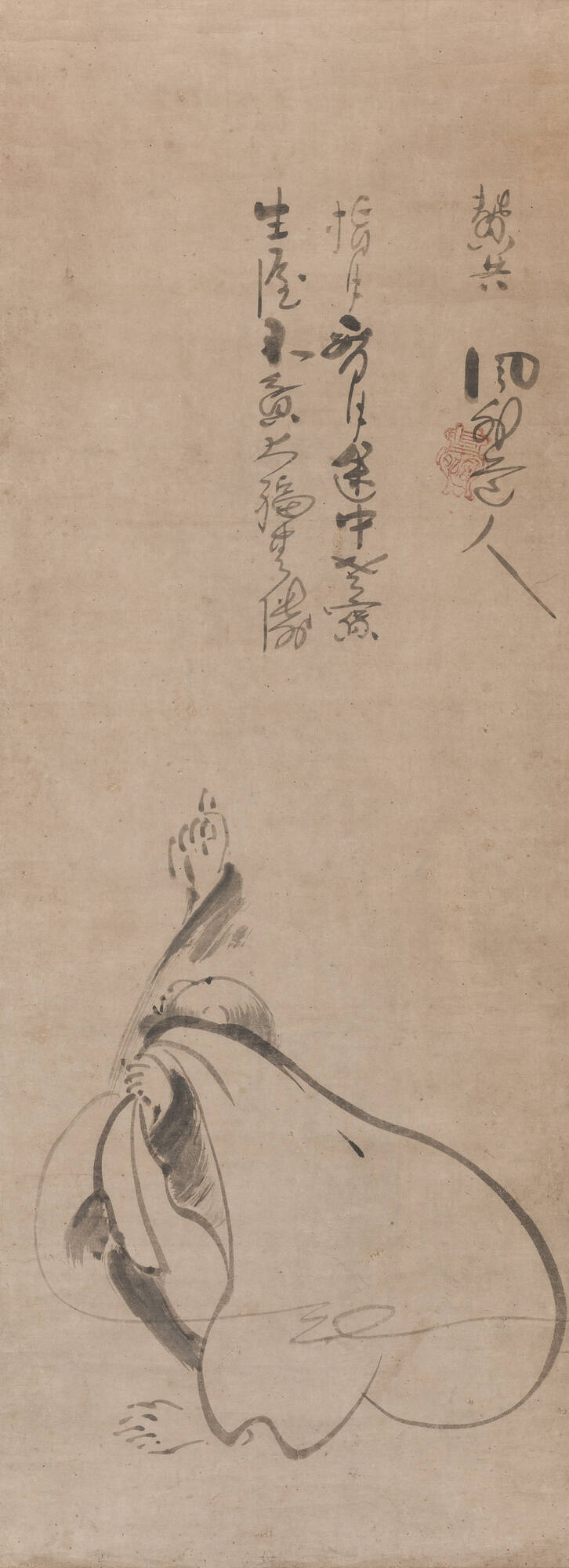
Inscribed:His life is not poorHe has riches beyond measurePointing to the moon, gazing at the moonTh(…)
Inscribed:His life is not poorHe has riches beyond measurePointing to the moon, gazing at the moonThis old guest follows the wayPainting and calligraphy as practiced by Zen Buddhist monks expresses through bold and direct imagery the quintessence of Zen teaching. The purpose of such works was to aid in meditation and their spontaneity and immediacy reflect Zen belief that satori, or enlightenment, can occur in an instant.One of the most important Zen monk-painters of the early Edo period, Fugai lived as a recluse, sometimes in caves or in remote villages, and for many years he just wandered, spending only a few relatively short periods of residence at temples. Among his favorite subjects were Daruma, the patriarch of Zen, and Hotei, the tenth-century eccentric Chinese monk who came to be venerated as the “god of good fortune.” This image of Hotei, executed in gray, wet strokes with only spare use of black, characterizes the Zen figural style known as “ghost” or “apparition” painting. Here Fugai presents the wandering monk Hotei with his treasure bag, pointing to the moon, in an image and accompanying poem that conveys the pure joy of nonattachment. (“Moon,” curated by Ellen Avril and presented at the Johnson Museum August 25, 2018-January 13, 2019)