




Indonesia, Bali, Negara
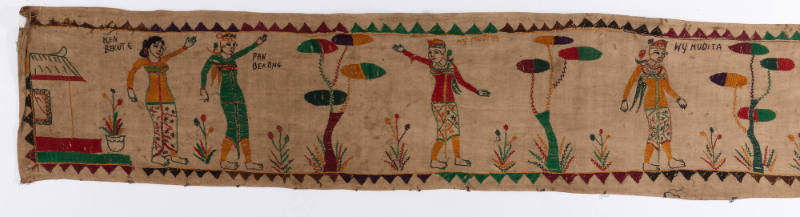
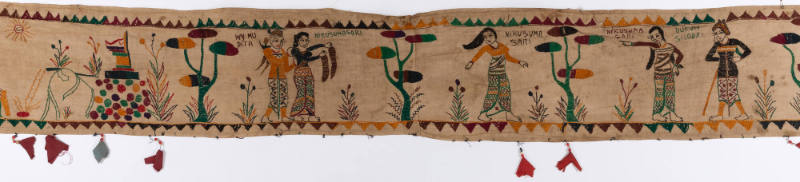
Eave hanging (ider-ider) with scenes of Mudita, from the Journey of Dukuh Siladri




Object Details
Culture
Indonesia, Bali, Negara
Medium
Cotton embroidery on cotton cloth
Dimensions
9 7/16 x 361 7/16 inches (24 x 918 cm)
Credit Line
Acquired through the George and Mary Rockwell Fund
Object
Number
2007.031.084
There once lived two brothers, Siladri and Made Kerti. They were both raised in the city of Mameling(…)
There once lived two brothers, Siladri and Made Kerti. They were both raised in the city of Mameling by their widowed mother, Ni Sabuk, who secretly adopted Siladri as a baby. Made Kerti was her natural-born son, but she treated them both equally and with love. The brothers married: Siladri chose Kadek, with whom he had a son Mudita; and Kerti found his match in Rajin, who gave birth to a daughter, Kusumasari. Both families were happy at first, but Siladri grew restless, discontented with life in Mameling.One day Siladri decided that he wanted to go into the forest and pursue the life of an ascetic. Inspired by all the palm leaf manuscripts in his father’s library, he resolved to seek out the sage Mpu Dibiaja, who lived near Gunung Kawi. Balinese tradition requires that a male son should stay in the family home, so the bittersweet decision is made that Mudita should stay in Mameling with his aunt and uncle, Kerti and Rajin, and Kusumasari will join Siladri and Kadek on their journey. Siladri makes a special ring for his son and gives it to Made Kerti for safe keeping. Siladri and Kadek set out on their journey, takingturns carrying the infant, Kusumasari.This embroidered ider-ider focuses on the long journey of Mudita as he walks to Gunung Kawi and home again to Mameling, repeatedly changing the color of his traveling cloths. On the journey he is attacked by Buyar’s minions and must fight them. At last, he arrives at Gunung Kawi and is reunited with Kusumasari and his father, Dukuh Siladri. This much longer cloth would have wrapped around a shrine. Most fascinating are the vignettes in the center where Kusumasari can be seen kneeling by a sacred spring in front of a polka-dotted shrine. Three shafts of colored threads in satin stitch splay from her hands as she performs her power (sakti). In the sky above her, a sun face can be seen revealing her power for good.