

Object Details
Culture
Chorrera (Ecuador)
Date
1100–400 BCE
Medium
Earthenware
Dimensions
2 3/16 × 7 1/2 inches (5.6 × 19 cm)
Credit Line
Gift of Thomas Carroll, PhD 1951
Object
Number
2006.070.028
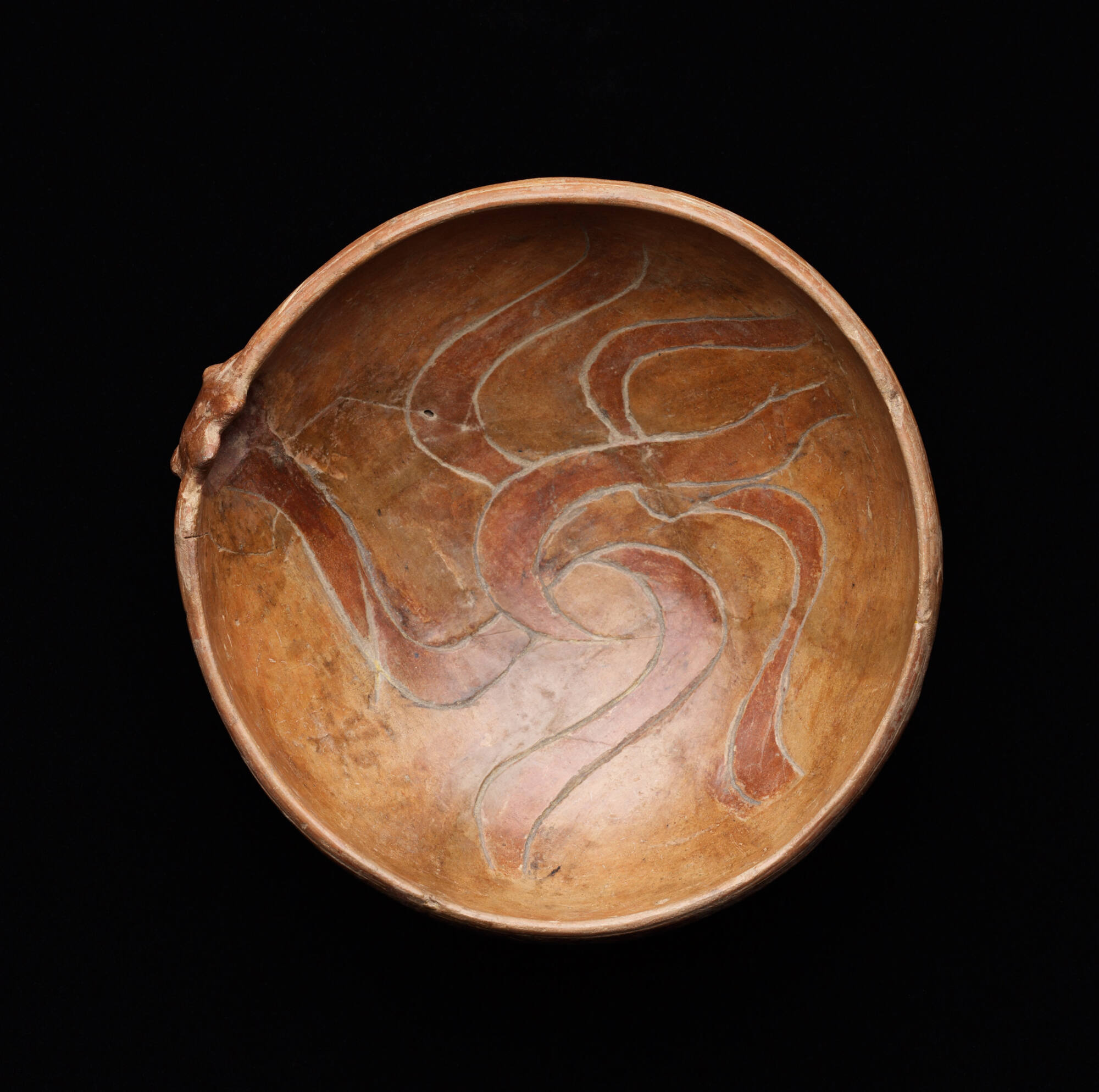
BRIEF DESCRIPTIONThis broad, shallow Chorrera ceramic bowl has a bat head on the rim. Bats were popu(…)
BRIEF DESCRIPTIONThis broad, shallow Chorrera ceramic bowl has a bat head on the rim. Bats were popular animals in Chorrera art.WHERE WAS IT MADE?This bowl was made in what is now Ecuador.HOW WAS IT MADE?This bowl was likely made with the coil method. In this method, a base is made by shaping clay into a flat disc. Then hand formed coils of clay, like ropes, are successively added to one another, building up the walls of the bowl. A tool such as a wooden paddle is used to smooth the sides both inside and out, leaving no trace of the coils. The color of the bowl comes from two tones of orange and red slip. Slip consists of clay and sometimes minerals that have been mixed with water to form a type of paint. This is applied to the vessel prior to firing. The inside of the bowl is decorated with incised lines. These were also added before the bowl was fired, while the clay was still pliable.HOW WAS IT USED?Although we don’t what specific foods might have been served in this bowl, we do know what foods were consumed. Staples included maize (corn) and manioc (tapioca) in lowland areas and quinoa, potatoes, and other Andean tubers in highland areas. A wide variety of fruits and vegetables were eaten, including beans, peppers, avocados, sweet potatoes, and peanuts. Animal foods included domesticated llamas and guinea pigs, wild animals such as deer and rodents, and marine resources, especially fish and shellfish. Trade with neighboring groups was widespread from very early times, so that people had access to foods from distant locales; for example, remains of seafood, such as fish bones, have been found quite far inland, and mountain crops such as coca leaves have been found in sites on the coast. While we may be able to make educated guesses about what was served, except for contact-period ceramics and for some grave goods, it is very difficult to determine who used any given piece of pottery, and under what circumstances. Were some vessels reserved for special guests, or for use by high-status elders? Were they used during special religious ceremonies or rituals? Was their use avoided by certain classes of people, such as children and/or menstruating women? As we venture farther back into the past, answering such questions becomes increasingly difficult. Although it is tempting to draw on information from modern traditional societies and from contact-period chronicles, inferences drawn from such sources must be used with care, especially when used to interpret objects distant in both space and time.WHY DOES IT LOOK LIKE THIS?Notice the bat head on the rim of the bowl. Bats are symbolic of divine mediation, as incarnate nocturnal “monsters:” improbable, near-fantasy combination animals which fly like birds, suckle their young at paired breasts like humans, and have pronounced fangs like jaguars and other cats. Like birds, bats are creatures of the air and may symbolize the spiritual flights taken by shamans during vision quests. To see other pre-Columbian objects with bat imagery in the Johnson Museum’s collection, search for object numbers 75.051.007 and 2000.116 in the keyword search box.Aspects of many different animals can be found on pre-Columbian pottery, textiles, and metalwork. They depict wild and domesticated animals, creatures commonly encountered in everyday life, and creatures found rarely—or not at all—in the natural world. These animals are often mixed with human attributes in what may appear to us to be startling fantasy combinations.ABOUT THE CHORRERA CULTURE:The Chorrera culture’s extended sphere of influence incorporated all three major Ecuadorian ecological zones: the coast, sierra (mountains), and Amazonia. While the Chorrera culture had its origins in the earlier Machalilla culture of the coast, certain aspects of its ceramic technology may have been influenced by the Ocós culture of Mesoamerica. The Chorrera people lived in small communities of 100-120 people, which seem to have supported craft specialists despite their small size. Fishing and farming were distinct occupations. The economy of the Chorrera people was based on farming, hunting and gathering. Trade along rivers and over the sea, especially trade in valuable stones such as lapiz lazuli, obsidian, and rock crystal, played an important role in the florescence of this culture. The highly burnished redware ceramics were decorated with black resist decoration, and feature an assortment of naturalistic animals and stylized human figures. Whistling bottles make their appearance during this period. The first cultural horizon in Ecuador to be widespread over a relatively large geographic region, the Chorrera people laid down a common cultural foundation upon which later cultures were built.