





Object Details
Culture
Nigeria, Yoruba people
Medium
Brass with dark brown patina
Dimensions
Part a: 9 × 1 1/4 inches (22.9 × 3.2 cm)
Part b: 8 7/8 × 1 1/4 inches (22.5 × 3.2 cm)
Credit Line
Gift of Arnold and Joanne Syrop
Object
Number
2002.027.004
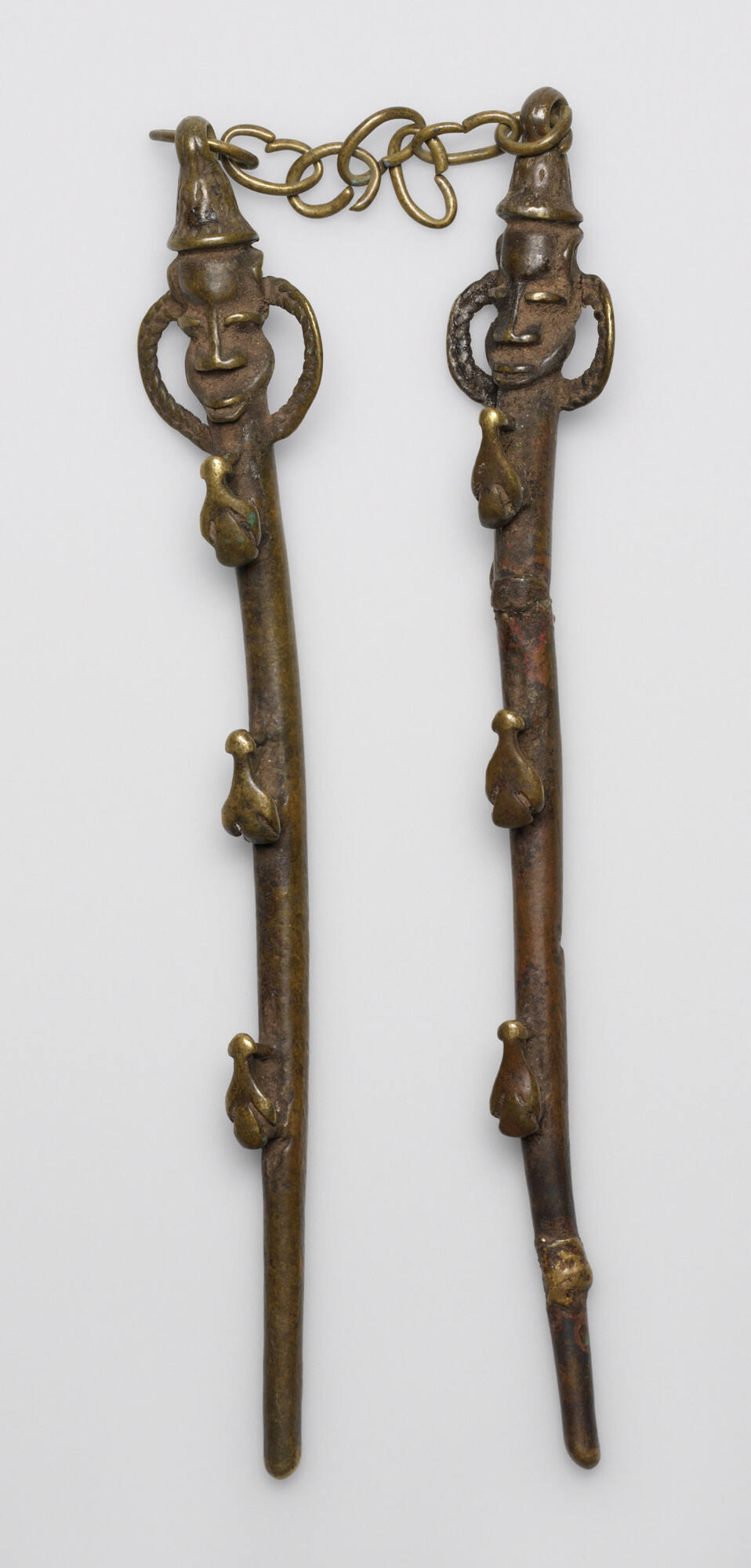
BRIEF DESCRIPTIONYoruba members of the Ogboni society understand this pair of staffs to be a single (…)
BRIEF DESCRIPTIONYoruba members of the Ogboni society understand this pair of staffs to be a single object, the edan, which embodies the Earth spirit. Representing one male and one female figure and linked by a chain, the edan symbolizes the necessary connection between the sexes.WHERE WAS IT MADE?This was made in Nigeria, where the Yoruba people live.HOW WAS IT MADE?These staffs were made from brass by a Yoruba blacksmith. First a clay core was made, then wax was wrapped around the core and details, such as the facial features and birds, were modeled out of additional wax. Then the entire surface was covered with clay, except for one hole. The whole ensemble was heated to melt the wax. Once the melted wax was poured out through the hole, molten brass was poured into the remaining space. When the brass cooled, the outer layer of clay was broken and removed to reveal the figure.HOW WAS IT USED?The prestigious Ogboni society includes both male and female elders. Ogboni elders would wear edan Ogboni draped over their necks. Although the functions of the Ogboni society have narrowed considerably in recent decades, members traditionally select, install and bury kings, judge criminal cases, and issue punishments, including the removal of delinquent kings. Edan Ogboni function as public signs of the society’s power. For example, a messenger of the Ogboni greets the recipient of the communication by tapping the edan on his forehead then chest. The recipient acknowledges the authority and message of the Ogboni by doing the same. Other functions of the edan object include its protective use: the edan may not be crossed if it is placed at a building threshold. Conversely, because Ogboni members had the power to punish, the edan thrust into the ground signified a death sentence. WHY DOES IT LOOK LIKE THIS?The male and female figures represent the necessary connection between the sexes. Even the materials used to make an edan symbolize the importance of both sexes; the edan are made from cast bronze (a material associated with women and female deities), but each figure has a clay and iron core (the latter material associated with men and male deities).Much of Yoruba figurative art depicts faces with prominent, elliptical eyes. Notice that the eyes of the edan figures do not feature the pupil or iris. Rather, the eyes appear intense, yet serene. Notice the dark patina on the surface of the edan; most edan in museum collections are relatively free of patina. Although Ogboni members regularly pour libations of blood and peppers over the figures, the sculpture is cleaned shortly thereafter with lime juice and herbs.Notice the birds on the staffs; birds in Yoruba ritual art usually refer to “our mothers” – the mystical power of women, both alive and ancestral. These birds thus have the positive and negative connotations of women who are widely believed to have both the power to protect and the power to destroy. The birds reinforce the Ogboni society’s role as “king-makers.”To see other edan in the Johnson Museum’s collection, search for object numbers 91.001.052 and 92.005.035 in the keyword search box.