


Object Details
Artist
Zhang Xun
Date
1689
Medium
Handscroll: ink on paper
Credit Line
Gift of Mr. and Mrs. Rodney P. Henricksen
Object
Number
2002.173.002
Artist’s inscription: In the 6th day of the fourth month of the jise year (1689), in my studio on (…)
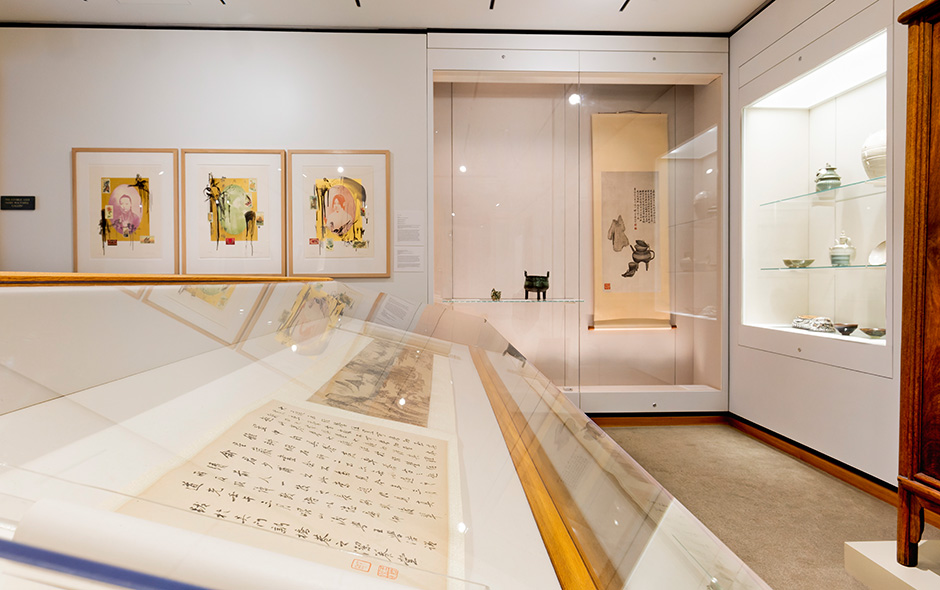
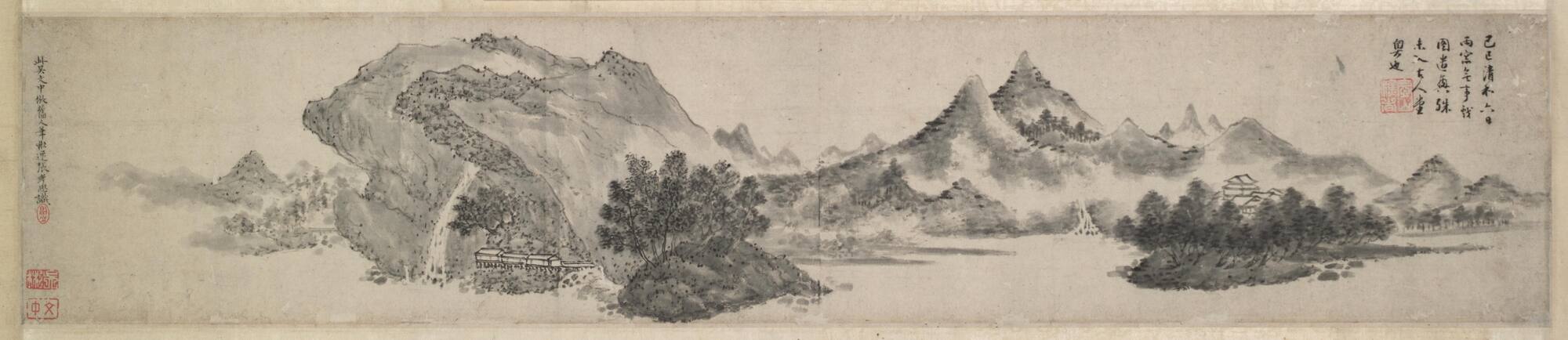
Artist’s inscription: In the 6th day of the fourth month of the jise year (1689), in my studio on a rainy day with no task in front of me, I playfully made this painting to express my exhilaration. I fear it does not come up to the standard of the old masters. Zhao Mengfu’s iconic landscape handscroll Autumn Colors on the Qiao and Hua Mountains was influential on Ming and Qing dynasty literati artists Dong Qichang (1555–1636) and Fang Shishu (1692–1751), who each painted their own versions of it, but in vertical format. Zhang Xun’s handscroll follows Zhao’s horizontal composition with the pointed peak of Mount Hua to the right and rounded form of Mount Qiao at left. Playfully reinterpreting an earlier famous work has a long history in Chinese painting, and many contemporary artists continue to draw from past masters, as Xu Bing has in his animation.Zhang Xun became a jinshi (earned upon passing the highest-level civil service examination) in 1640 and served as a secretary in the Central Drafting Office until his retirement during the reign of Kangxi (1682–1722). (“Xu Bing: The Character of Characters,” curated by Ellen Avril and presented at the Johnson Museum August 11-December 23, 2018)Artist’s inscription (far right): In the 6th day of the fourth month of the jise year (1689), in my studio on a rainy day with no task in front of me, I playfully made this painting to express my exhilaration. I fear it does not come up to the standard of the old masters. (no signature)Inscription (at left): This is a painting by Wu Wenzhong [Wu Bin] after the manner of [?]; Zhang Xiaosi [hao] Lanyi recorded.Zhang Xun became a jinshi (earned upon passing the highest level civil service examination) in 1640 and served as a secretary in the Central Drafting Office. His family’s background was in the salt industry, a plum that made men rich. Zhang lived into the Kangxi era (1682¿1722) when he retired from office. This painting would have been done late in his life. According to one biographer, Zhang lived in poverty at this time and made a living selling his paintings.This landscape has two distinct sections: the first is in the manner of the Song master Mi Fu; a conical mountain done in wet horizontal strokes. The second scene depicts a series of houses built on stilts over water which define a circular pathway around the base of an overhanging cliff. The large rocky mass is textured with lively dry brushstrokes and peppered dots called dian, all of which breathe life into the landscape.


