


Object Details
Artist
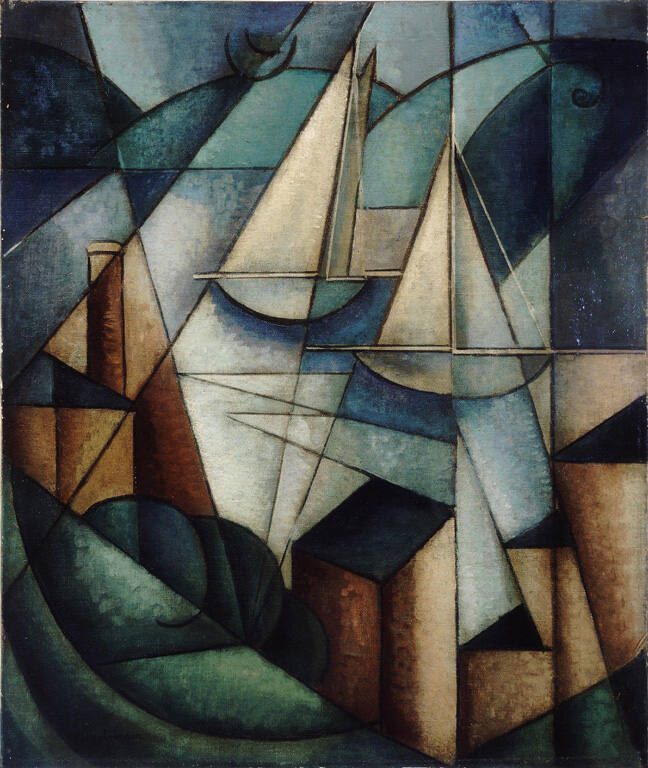
Jean Metzinger
Date
ca. 1912
Medium
Oil on canvas
Dimensions
Image: 21 5/8 × 18 3/16 inches (54.9 × 46.2 cm)
Frame: 30 3/8 × 27 × 2 inches (77.2 × 68.6 × 5.1 cm)
Credit Line
Acquired through the Membership Purchase Fund
Object
Number
79.058.001
Provenance:
ca. 1912– collection of the artist. n.d. collection of Léonce Rosenberg, Galer(…)
Provenance:
ca. 1912– collection of the artist. n.d. collection of Léonce Rosenberg, Galerie l’Effort Moderne, Paris. (1962 sold through Parke Bernet, New York, auction March 21, 1962, sale #2096, lot #95); probably 1962–1979 collection of Ambassador Arnold Saltzman, Premiere Galleries, New York (probably purchased through Parke Bernet); (1979 with James Goodman Gallery, New York (on consignment from Premiere Galleries)); 1979 collection of Herbert F. Johnson Museum of Art, Cornell University, Ithaca (purchased through James Goodman Gallery)
——
Label Text:
The greatest liberating pictorial style of the twentieth century was the Cubism developed by Picasso and Braque in the first years of the century. For some artists, it led to abstraction; for others, it was merely a style to be adapted to pre-existing approaches to picture making. For Metzinger, Cubism was a system by which multiple perspectives could be juxtaposed on a single plane; his almost monochromatic palette meant that the viewer is not distracted from the study of perspective. Metzinger was an early proponent of Cubism and wrote some of the first important theoretical essays on it. On Cubism, written in 1912 with his fellow Cubist Albert Gleizes, was the first theoretical work devoted to the new movement and played a major role in its recognition. Metzinger himself often experimented with Cubist techniques, but his work differs from other Cubists in that his paintings retain a recognizable scene, here a landscape, a fairly rare subject for the early Cubists, with a system of mathematically calculated proportions, planes, and angles superimposed on it, like a grid. In the works of Picasso and Braque, small rectangular planes first go above, then below, then simply fade into other planes; Metzinger reduced his recognizable subjects into a series of rationally calculated and plotted planes, each laid over the other, as they move back in depth. (From “A Handbook of the Collection: Herbert F. Johnson Museum of Art,” 1998)