



Object Details
Artist
Andy Warhol
Date
1964
Medium
Screenprints on linen
Dimensions
Support: 49 x 37 3/4 inches each (124.5 x 95.9 cm)
Frame: 51 5/8 × 40 3/4 × 2 1/16 inches each (131.1 × 103.5 × 5.2 cm)
Credit Line
Acquired with funds provided by the National Endowment for the Arts, and through the generosity of individual donors
Object
Number
76.048 a,b
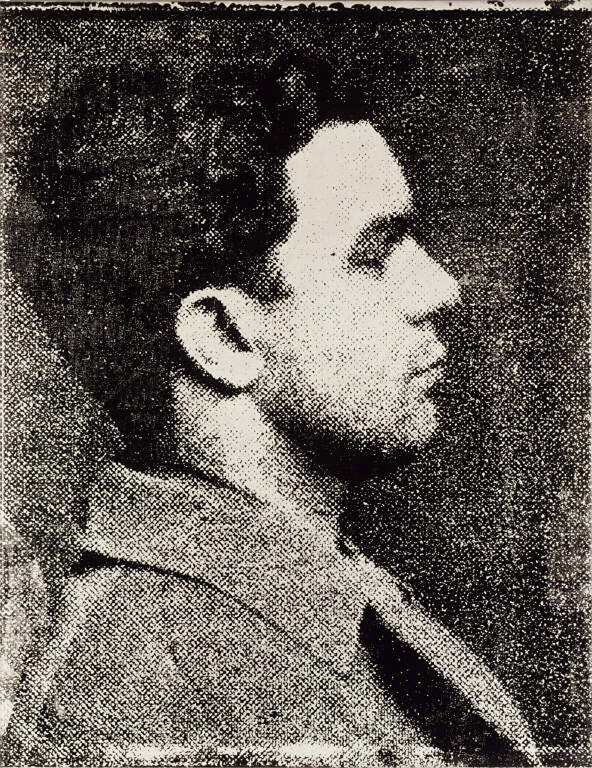
Most Wanted Men No. 1, John M. is from a set of paintings for which Warhol used silkscreen(…)
Most Wanted Men No. 1, John M. is from a set of paintings for which Warhol used silkscreens that were originally produced for a mural commissioned by architect Philip Johnson for the 1964 New York World’s Fair. Johnson had invited ten emerging artists—among them John Chamberlain, Robert Indiana, Ellsworth Kelly, Roy Lichtenstein, Robert Rauschenberg, James Rosenquist, and Warhol—to produce new work for the gray exterior of his New York State Pavilion. For his assigned twenty-by-twenty-foot space, Warhol chose to enlarge the mug shots of the New York Police Department’s thirteen most wanted criminals of 1962. Thirteen Most Wanted Men was installed by April 15, 1964, but painted over with silver paint only a few days later, before the public opening of the fair. In line with other work Warhol was making at the time, now known as the Death and Disaster series—for which he appropriated new media imagery of suicides, car crashes, an electric chair, and dismembered bodies—the mural was meant to illustrate the violence of American society of the time, and was certainly not an image of the country that the fair organizers wanted to perpetuate.
Between making the mural and the set of paintings, Warhol adjusted the format of the individual images from square to a more vertical size, “emphasizing their presence as portraits,” curator Larissa Harris noted in the Queens Museum’s 2014 catalogue and exhibition 13 Most Wanted Men: Andy Warhol and the 1964 World’s Fair, to which the Johnson lent its diptych. “In 1963,” Harris continues, “Warhol produced his first portrait commission, Ethel Scull Thirty-Six Times, based on a session with the socialite in a Times Square photo booth.” During that same period, pioneering Detroit collector Florence Barron also commissioned Warhol to paint his first self-portrait for her. Also based on photo booth images, the four-part painting shows the artist wearing his trademark sunglasses, catapulting him from commercial artist into the quintessence of sixties cool. By comparing the industrial and pop culture aspects of the mug shot and the photo booth, Harris argued that “Thirteen Most Wanted Men can be seen as part portrait, part Disaster.” With the mug shots arranged in such a way that many of the men were looking at each other, some critics have suggested that the mural also contained homosexual references.
(Andrea Inselmann, A Handbook of the Collections, 2018)