

Object Details
Culture
Teotihuacán (Mexico)
Date
ca. 250–550 CE
Medium
Clay, slip, gesso, and pigments
Dimensions
Height: 6 inches (15.2 cm)
Diameter: 7 1/8 inches (18.1 cm)
Credit Line
Acquired through the Membership Purchase Fund
Object
Number
70.169
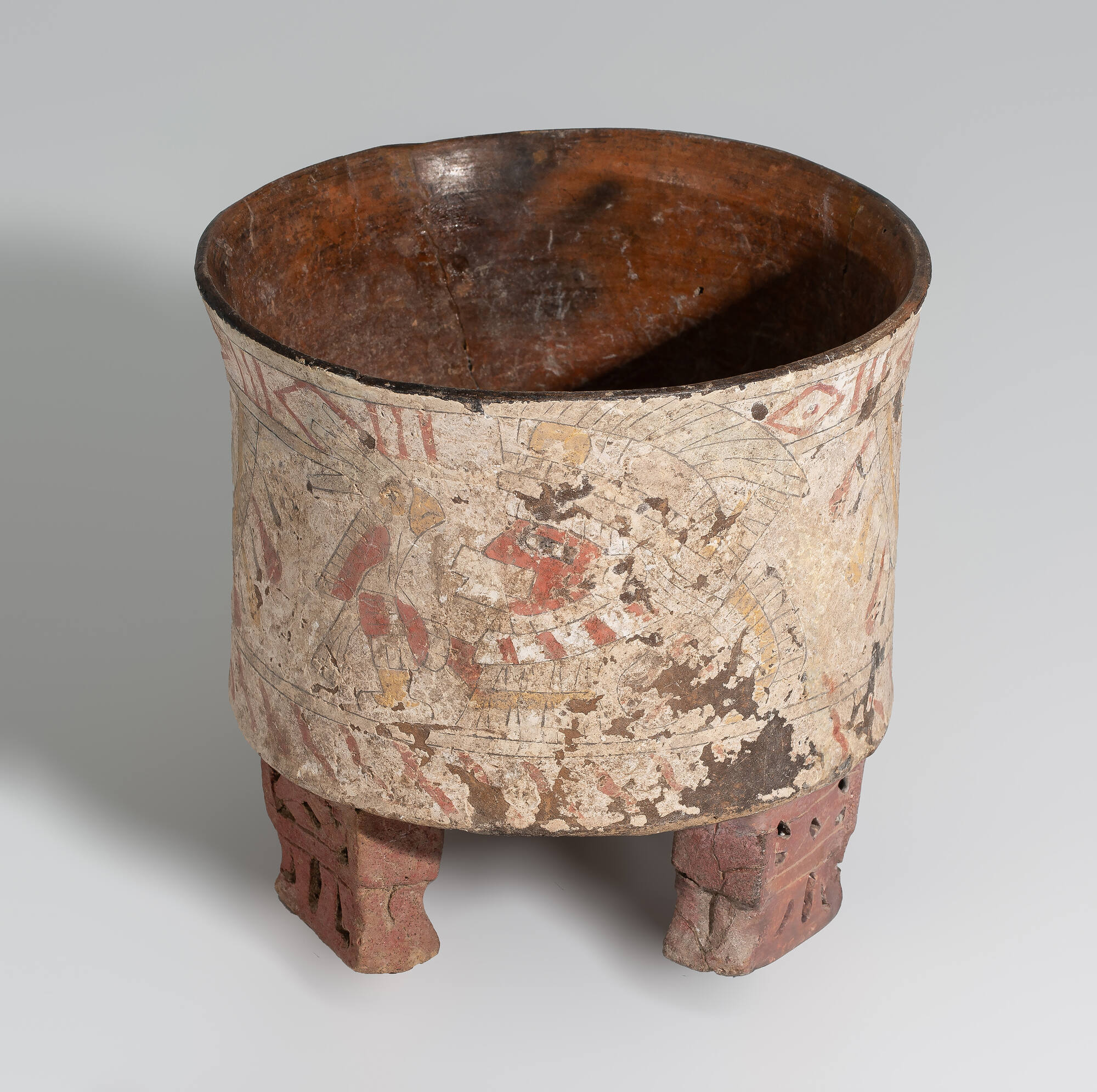
BRIEF DESCRIPTIONThis is a characteristic Teotihuacán style cylindrical tripod vessel.WHERE WAS IT (…)
BRIEF DESCRIPTIONThis is a characteristic Teotihuacán style cylindrical tripod vessel.WHERE WAS IT MADE?This vessel was made in what is now Mexico, specifically in the Teotihuacán Valley, near Mexico City.HOW WAS IT MADE?We do not know for sure how these ceramic tripod vessels were produced, although it seems likely that the walls were made from flat, rolled out slabs of clay, attached to a flat disc base. The supports were likely modeled from flat slabs and attached separately. After the vessel was fired in an earthen pit to harden the clay, the outside was coated with a white base of gesso or stucco, made from the mineral calcite (in the form of a lime plaster). Other pigments derived from minerals were then used to paint the decorations onto the surface of the gesso.HOW WAS IT USED?Except for contact-period ceramics and for some grave goods, it is very difficult to determine who used any given piece of pottery, and under what circumstances. Were some vessels reserved for special guests, or for use by high-status elders? Were they used during special religious ceremonies or rituals? Was their use avoided by certain classes of people, such as children and/or menstruating women? As we venture farther back into the past, answering such questions becomes increasingly difficult. Although it is tempting to draw on information from modern traditional societies and from contact-period chronicles, inferences drawn from such sources must be used with care.WHY DOES IT LOOK LIKE THIS?The form of this vessel, with its tripod feet, is characteristic of Teotihuacán ceramics. This one is decorated with ritual scenes.To see another Teotihuacán object in the Johnson Museum’s collection, search for object number 73.013.003 in the keyword search box.ABOUT TEOTIHUACÁN:The rise of Teotihuacán as a major Mesoamerican city began by AD 150 and lasted until the city was burned in the sixth or seventh century AD. At its height, circa AD 550, Teotihuacán was a city of some 125,000 inhabitants—the sixth largest city in the world—whose prestige and influence were rivaled only much later by Tenochtitlan, the great capital of the Aztecs located on the present site of Mexico City. The “talud-tablero” is a distinctively Teotihuacano architectural style, having vertical elements (the “tablero”) surmounting the slope of the lower “talud.” The vertical “tablero” was frequently decorated with brightly painted raised-relief murals incorporating images of feathered serpents and other Mesoamerican deities. Similar iconography is found on the footed tripod pottery vessels (such as this one), which are also characteristic of this culture. Other material culture of note includes elaborate mosaic greenstone masks and extraordinarily thin pottery vessels with lifelike human figures.