


Charles T. Scowen
(British, active late 19th century in Ceylon)
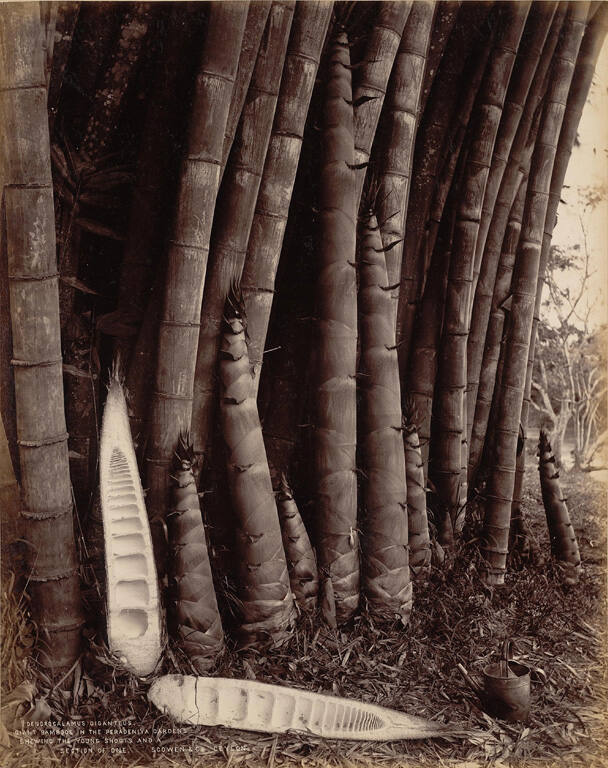
Giant bamboo in the Peradeniya gardens, Ceylon
Object Details
Artist
Charles T. Scowen
Date
ca. 1880
Medium
Albumen print
Dimensions
Image: 11 × 8 3/4 inches (28 × 22.2 cm)
Mount: 15 1/4 × 11 inches (38.7 × 28 cm)
Credit Line
Gift, by exchange, of Arthur Penn, Class of 1956, and Marilyn Penn; Christopher Elliman; David Elliman; and Andrea Branch
Object
Number
92.069.005
This striking graphic image of a bamboo thicket gives precedence to the Royal Botanic Gardens in Per(…)
This striking graphic image of a bamboo thicket gives precedence to the Royal Botanic Gardens in Peradeniya, near Kandy, Sri Lanka, founded in the mid-nineteenth century. Earlier it was the location of native Kandy rulers as far back as the fourteenth century, until a temple built by them was destroyed by the British and taken over in the early nineteenth century. Here, a single bamboo is spliced open and propped up, as if to offer keen colonial botanists a glimpse, next to a strategically placed water canister.
Gardens and plantations are examples of brutal colonization of the landscape, supplanted by species of plant varieties uprooted from multiple locations to showcase biodiversity and conservation. Such photographs also fall in line with colonial paintings of flora and fauna made by local artists in the Indian subcontinent and commissioned by East India Company officials invested in botany, zookeeping, and hunting. The formation of botany as a scientific, taxonomic discipline emerged from colonial voyages and expeditions and was designed to wipe out local knowledge and natural habitat, rendering science instead as universal and entrenching colonial systems of power, knowledge, and extraction. Charles Scowen, who set up a photo studio in Colombo known for plant and animal studies, eventually became a tea planter.
—Ayesha Matthan, PhD candidate


