

Object Details
Culture
Japanese
Date
19th century
Medium
Gold lacquer on wood
Dimensions
Diameter: 2 3/4 inches (7 cm)
Credit Line
Gift of Drs. Lee and Connie Koppelman
Object
Number
98.087.006
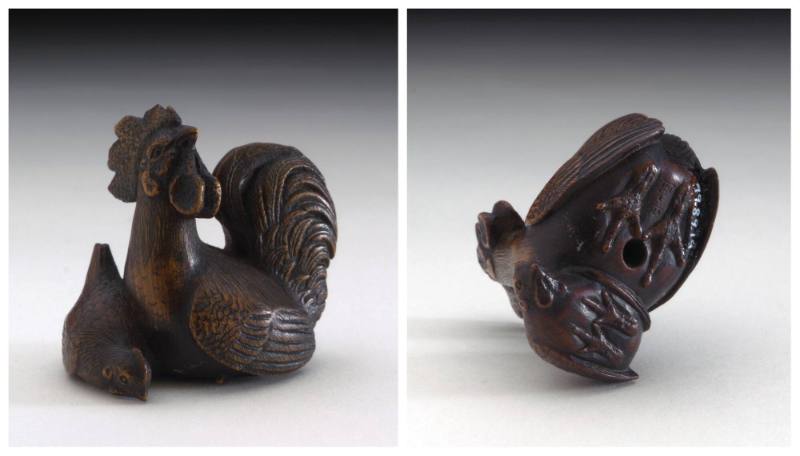
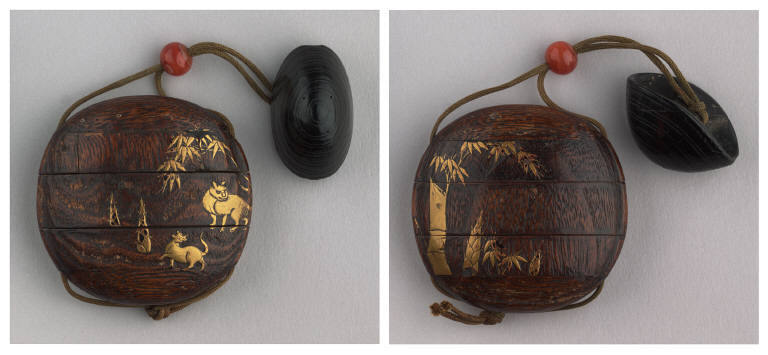
BRIEF DESCRIPTIONThis is a wooden inro, complete with an ojime (the bead that keeps the cords secure(…)
BRIEF DESCRIPTIONThis is a wooden inro, complete with an ojime (the bead that keeps the cords secure and tight) and a netsuke.WHERE WAS IT MADE?This inro was made in Japan.HOW WAS IT MADE?This inro was hand-carved from wood and decorated with gold lacquer. The netsuke (the toggle at the end of the cord) is coated with black lacquer. Japanese lacquer (urushi) is derived from the sap of the Rhus verniciflua tree, a member of the plant family that includes poison oak, poison ivy, and poison sumac. Its extreme toxicity poses a danger for lacquer artisans. Lacquer is made by carefully building up thin layers of sap and letting each layer dry under warm, humid conditions. Once dry, the sap becomes rigid and impervious to water, insects, and most solvents.HOW WAS IT USED?During the Edo period (1603-1868), the standard attire for a well-dressed Japanese man consisted of a kimono tied with a sash. Because kimonos had no pockets, accessory bags and carrying cases (called sagemono: hanging things) were used to hold personal items such as money, medicines, tobacco and seals (a stamp carved with the owner’s name). Silken cords, attached to the sagemono, were threaded through the kimono sash (obi). A toggle, called a netsuke, was attached to the other end of the cord to prevent it from slipping through the sash. The inro was used to carry medicines and other personal items. The compartments securely lock together when the cords are tightened, and separate when the cords are loosened.WHY DOES IT LOOK LIKE THIS?This inro is decorated with a scene of bamboo and two feline-looking animals, possibly tigers. Although inro and their netsuke are often made around a unifying theme, this pairing seems unrelated.To see another inro and netsuke ensemble that is thematically related, search for object number 73.005.178 in the keyword search box.