

Michael Goldberg
(American, 1924–2007)
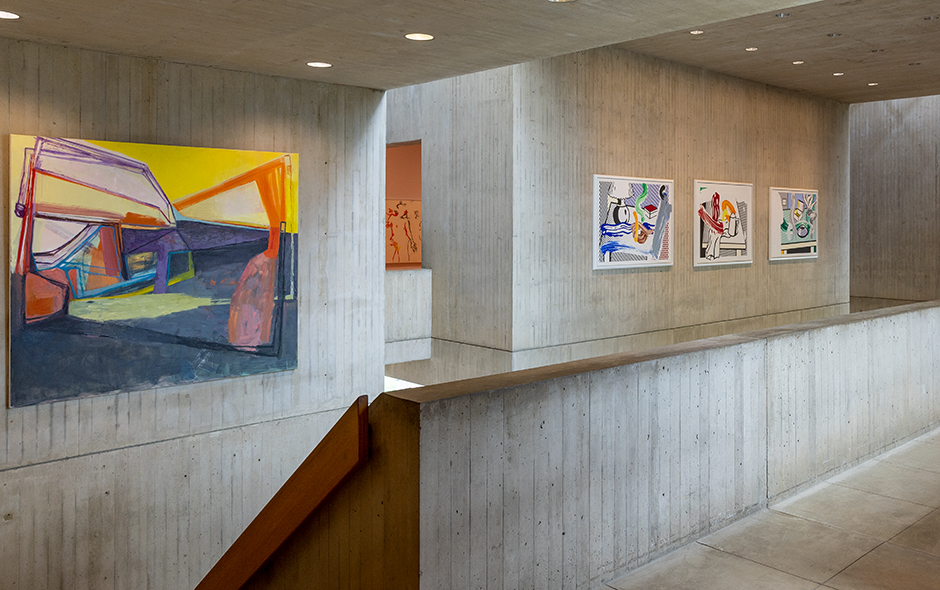
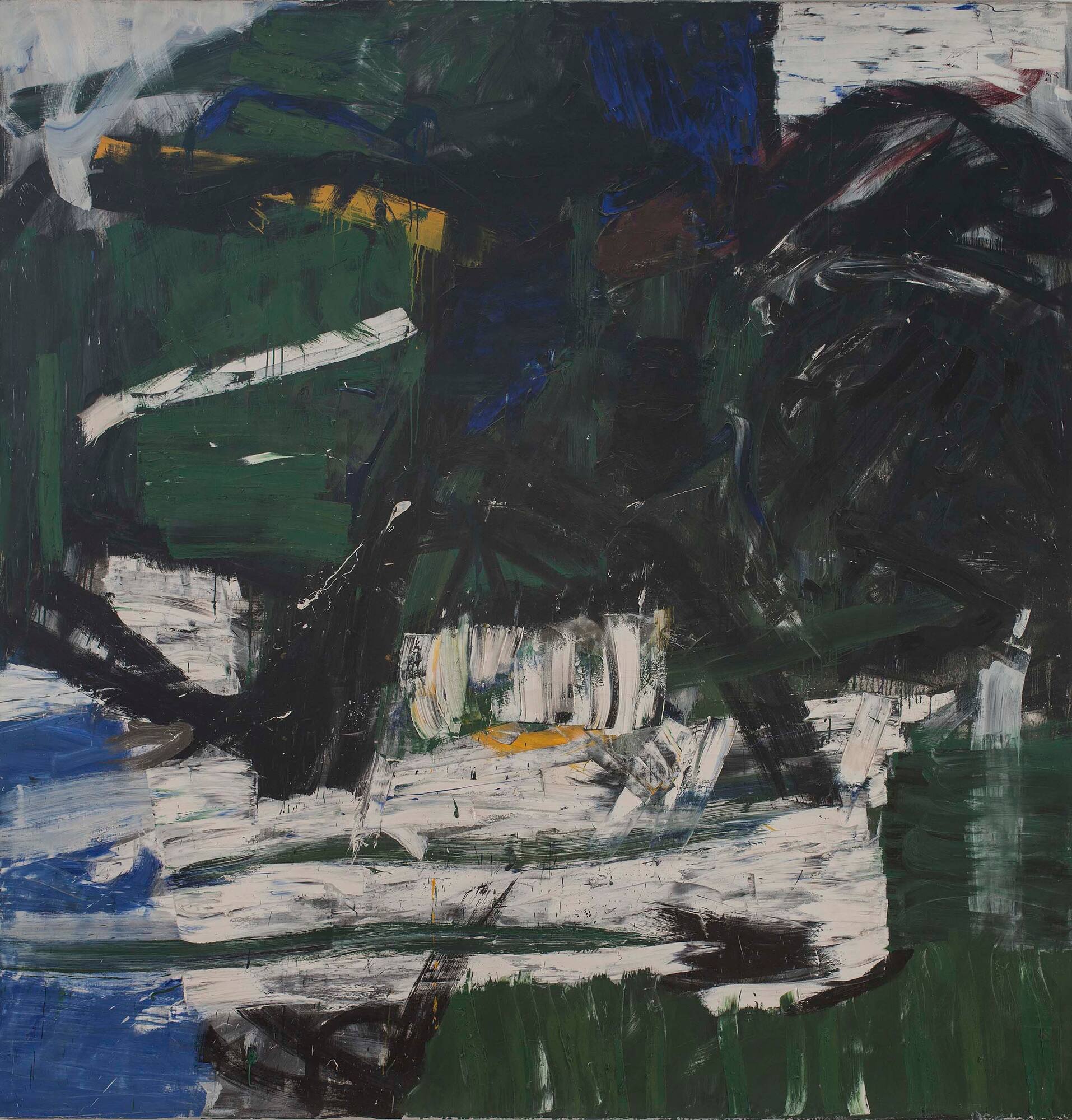
Last Building on Park Avenue That Has an Inner Court That’s Soon to Be Demolished
Object Details
Artist
Michael Goldberg
Date
1958–59
Medium
Oil on canvas
Dimensions
Image: 111 13/16 × 107 7/8 inches (284 × 274 cm)
Frame: 112 × 108 × 1 3/4 inches (284.5 × 274.3 × 4.4 cm)
Credit Line
Anonymous gift through the American Federation of Arts, Museum Donor Program
Object
Number
59.142
In 1959, the American Federation of Arts established the Museum Donor Program to fund the acquisi(…)
In 1959, the American Federation of Arts established the Museum Donor Program to fund the acquisition of “works of art by younger, less well-known American artists” by selected museums, particularly at colleges and universities. The donors behind the program, Audrey Bruce Currier and Stephen Richard Currier, remained anonymous until their death in a plane crash in 1967. Cornell’s A. D. White Museum was one of the thirty-five institutions selected for the program, under the leadership of legendary art historian and curator Alan R. Solomon, the first director of the White Museum. The three works acquired—by Lee Bontecou (59.140), Robert Rauschenberg (59.141), and Goldberg (59.142)—are among the most significant works in our permanent collection of contemporary art.
While Rauschenberg and Bontecou’s pieces ushered in a period of American art that would see conventional categories like painting and sculpture challenged, Goldberg’s contributions got caught up in, as art historian Robert Rosenblum noted, “the prejudices of a moment or a generation.”
Goldberg has often been referred to as a member of the second-generation abstract expressionists. Dubbed “the lost generation” in his revisionist exhibition catalogue, Action/Precision: The New Direction in New York, 1955–60, curator Paul Schimmel argued, “As with the movements immediately following the impressionist and cubist breakthroughs, the younger generation abstract expressionists have found their own aesthetic contributions obscured by the tremendous aesthetic upheavals that preceded them.” Focusing on a group of six abstract painters during the most explosive decade in American art, the 1950s—among them Goldberg, Norman Bluhm, and Joan Mitchell—Schimmel’s 1985 exhibition intended to show how this younger generation was “able to extend and invigorate a tradition that was less than ten years old.”
As a young man Goldberg took classes at the Art Students League of New York and in the early 1950s he studied painting with Hans Hofmann, from whom he learned the dynamic push-pull of pure color and the use of still life elements. Goldberg used the still life format for his energetic, often cubist-structured paintings in these early years, incorporating images of tables, chairs, windows, lamps, and food. Owing a certain debt to Willem de Kooning, some of these still lifes also include found objects or words arranged in dynamic rhythms, showing his interest in jazz and poetry of the time. Last Building is part of his most important series of paintings from the late 1950s, the “house paintings,” which Goldberg named as such only after he had painted several canvases that seemed to contain a centralized, architectural form. Combining dense layers and transparent washes of paint, Goldberg reintroduces a tension between flat surface and a compressed third dimension, unlike the first-generation painters.
(Andrea Inselmann, A Handbook of the Collections, 2018)