






Object Details
Culture
Dan (Liberia)
Medium
wood and fabric
Dimensions
9 x 5 1/2 inches (22.9 x 14 cm)
Credit Line
Gift of John Eriksen, Class of 1961, and Betsy Eriksen
Object
Number
82.114.002
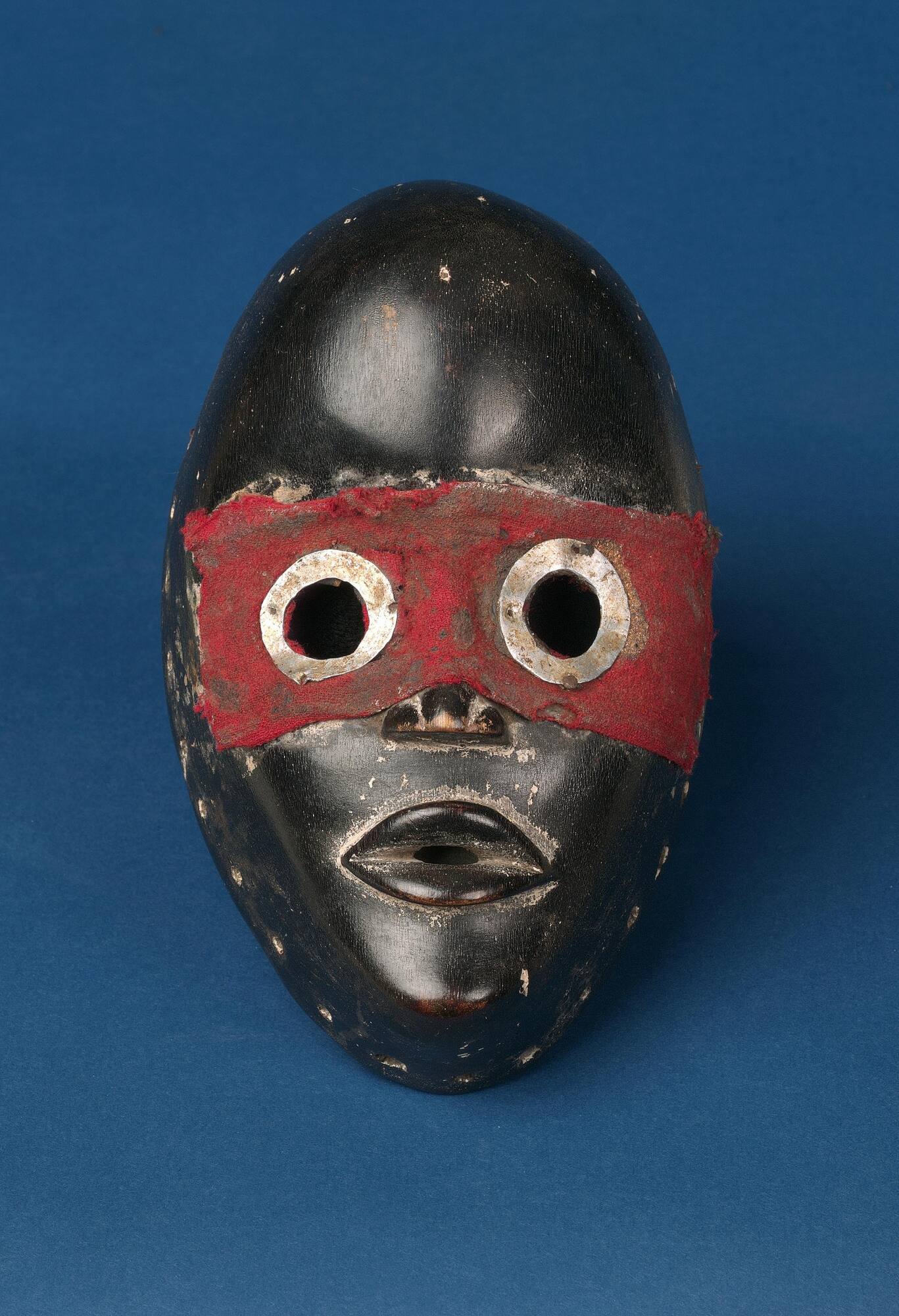
BRIEF DESCRIPTIONThe Zakpei ge mask embodies the spirit of fire prevention. Maskers would wear this (…)
BRIEF DESCRIPTIONThe Zakpei ge mask embodies the spirit of fire prevention. Maskers would wear this mask only during the dry season. They function as fire police, ensuring that women have concluded their daily cooking and extinguished the fires before the savanna wind kicks up around noon. WHERE WAS IT MADE?The Dan are an ethnic group of approximately 350,000 people who live in the West African countries of Liberia and the Ivory Coast. HOW WAS IT USED?This mask was carved from wood. The artist begins by using an adze to make the initial form and then uses chisels and knives to finish and refine the mask. The final form is smoothed with coarse leaves, then stained with oil or resin. Red fabric covers part of the mask, and thin strips of metal (likely tin) outline the eyes. To see a Dan adze in the Johnson Museum’s collection, search for object number 86.015.006 a,b in the keyword search box.HOW WAS IT USED?Zakpei ge maskers (who are always men) appear only in the dry season. They function as fire police who ensure that women have concluded their daily cooking and extinguished the fires before the savanna wind kicks up around noon. A negligent woman or her husband is required to appear before the village assembly and pay a hefty fine; a woman may also experience the additional humiliation of having her cooking pot seized. As the spirit of fire prevention, the Zakpei ge wears a headdress of large green leaves and carries a fresh branch. He would also wear a costume with anklets, bracelets and neck ornaments. The Zakpei ge may also be accompanied by an attendant who hits a gong –presumably to warn village women of Zakpei ge’s approach. Today, most houses in Dan communities have zinc roofs, lessening the likelihood of fire and therefore the use of this type of mask.Dan people believe that an essential force called dü is present in all parts of the world – in all animate and inanimate objects. Dü is particularly manifest in spirits who usually reside in the mountains and rely on humans to create masquerades so that the spirits may take corporeal form. Unlike many other African masquerades, the mask does not lose its spirit if damaged; nevertheless, the spirit may choose to abandon the mask, essentially leaving it dead. Finally, a mask spirit has little allegiance to its owner. If looted in war, the mask will transfer its power to the victor after appearing in a new owner’s dream.WHY DOES IT LOOK LIKE THIS?Dan artists take inspiration for the form and function of their masks from the appearance of spirits in their dreams. The masks are material forms made for the spirits to inhabit.Masks generally feature physical characteristics of either sex: female elements include elliptical eyes and an oval shape, whereas male facial qualities include a more angular eye and face shape, and a large overall size. Despite these gendered differences, masks are not believed to be male or female, but understood as pa, or “things.”To see other Dan masks in the Johnson Museum’s collection, search for object numbers 82.114.001, 89.016.007, 89.016.010, 91.001.008, and 91.001.014 in the keyword search box.Alexandra Lambert ‘09 contributed to this entry.