

Yamaguchi Soken
(Japanese, 1759–1818)
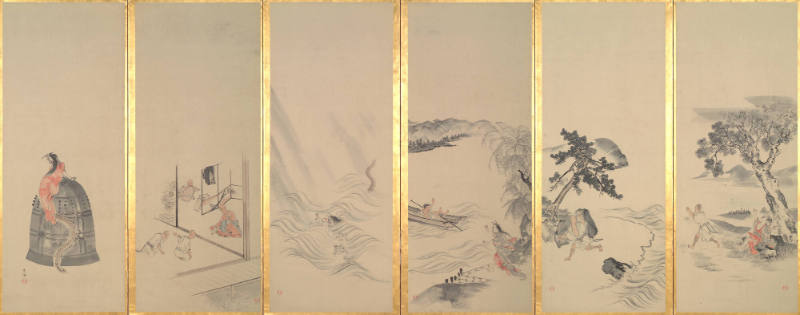
Dojoji Engi (illustrations to the Legend of Dojoji)

Object Details
Artist
Yamaguchi Soken
Medium
Pair of six-fold screens: ink, colors and gold on paper
Dimensions
Overall/Frame: 127 3/16 inches (323 cm)
Image: 66 15/16 × 24 7/16 inches (170 × 62 cm)
Credit Line
Acquired through the Herbert F. Johnson, Class of 1922, Endowment
Object
Number
82.047 a,b
Yamaguchi Soken, one of the ten best pupils of Maruyama Okyo (1733Ð1795), was well-known not only f(…)
Yamaguchi Soken, one of the ten best pupils of Maruyama Okyo (1733Ð1795), was well-known not only for his figure paintings but also for his woodblock printed books of traditional Japanese narrative paintings. This is one of a pair of six-fold screens depicts the Legend of Dojoji Temple; each of the twelve panels illustrates a significant moment in the tale, presented in a narrative sequence. Briefly, the legend tells the story of Kiyohime, the daughter of a wealthy man, who falls in love with the monk Anchin and, although he does not return her love, pursues him with unfortunate consequences for both. This screen illustrates the latter part of the story as follows (from right to left): the monk, Anchin, refuses Kiyohime and and runs away; Kiyohime grows claws and horns; Anchin crosses the river before Kiyohime catches him; a ferryman is shocked to see Kiyohime who is transformed into a snake-like demon and then swims across the river. A priest and his disciples hide Anchin who escapes to the Dojoji temple. Kiyohime, as the snake apparition, coils herself around a bell in which Anchin hides, burning the bell, the monk and herself together. As told by temple priests, the story is clearly didactic in its intent. Soken treats this supernatural story as another aspect of basic human emotions, and depicts the subject with an energetic, quick brush, enhancing the feeling of the mysterious and the ethereal with a judicious use of light color washes that suggest something of the mist enshrouding much of the action. (From “A Handbook of the Collection: Herbert F. Johnson Museum of Art,” 1998)