

Wedgwood, England
(founded 1759)
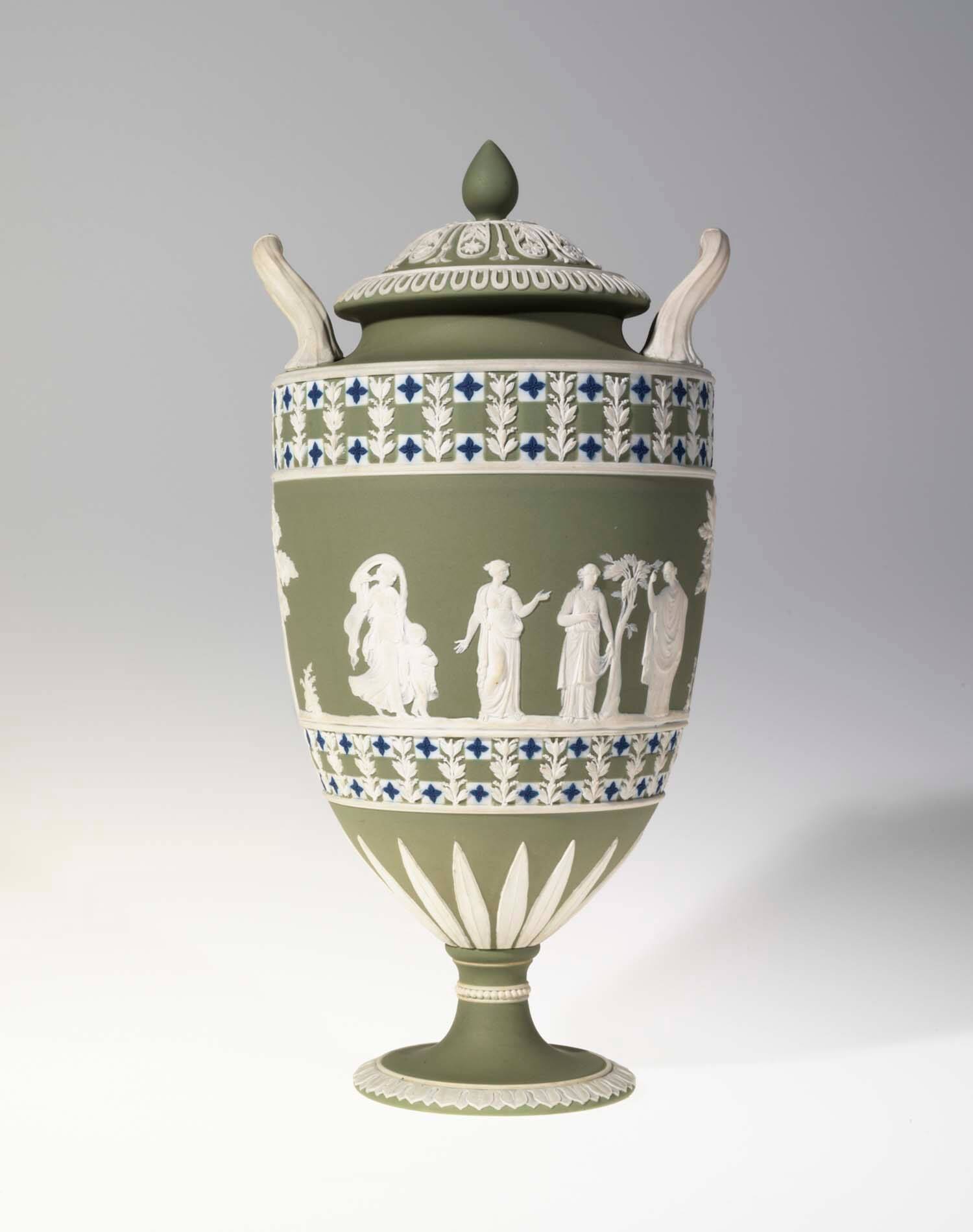
Jasperware lidded vase decorated with blue quatrefoils and classical figures
Object Details
Artist
Wedgwood, England
Date
ca. 1891-1908
Medium
Stoneware
Dimensions
12 3/4 × 6 1/2 inches (32.4 × 16.5 cm)
Credit Line
Transferred from Andrew Dickson White Residence
Object
Number
59.027
BRIEF DESCRIPTIONThis is a Jasperware lidded vase decorated with blue quatrefoils and classical figu(…)
BRIEF DESCRIPTIONThis is a Jasperware lidded vase decorated with blue quatrefoils and classical figures, made by Wedgwood.WHERE WAS IT MADE?The Wedgwood factory was and still is located in Etruria, Stoke-on-Trent in England. Etruria is an estate in Staffordshire bought by Josiah Wedgwood in 1769 as both home and factory site. The estate was named after the Etruscan pottery that was being excavated in Italy at the time.WHO WAS THE ARTIST?Josiah Wedgwood was born in 1730 in Staffordshire, England. After apprenticing to his older brother he opened his own pottery business, Josiah Wedgwood and Sons, in 1759. He was known for experimenting with various clay mixtures and glazes and invented several new types of stoneware, including jasperware. Queen Charlotte, wife of George III, appointed him queen’s potter in 1762. Wedgwood was also one of the original members of the Society for the Abolition of the Slave Trade and designed a famous medallion that served as an emblem of the anti-slavery movement in England. The company is still owned by descendants of Josiah Wedgwood.HOW WAS IT MADE?Jasperware is a form of stoneware, made of clay. The addition of barium sulphate makes the base clay perfectly white when fired. In the case of these urns, a color oxide was added to the clay used to make the main vessel, staining them each a hue of green. After the initial urn form was created with the use of a potter’s wheel, bas-relief (low relief) decorations, made in separate molds, were applied to the surface. The vessel was then fired in a kiln for 30 hours reaching a temperature of 1170 degrees centigrade.WHY DOES IT LOOK LIKE THIS?Notice the bas-relief (low relief) decoration on the urns: the imagery mimics scenes of classical antiquity. The revival of the styles and motifs of classical antiquity was an artistic and architectural style popular in the 18th to early 19th century, and is known as Neoclassicism. The style was a response to the philosophies of the Age of Enlightenment and the establishment of formal archeology, which uncovered new information about ancient cultures.