



Object Details
Culture
Baule peoples
Date
20th century
Medium
Wood and mixed media
Dimensions
Height: 28 inches (71.1 cm)
Credit Line
Gift of Dr. Leroy S. Lavine and Dorothy Lavine
Object
Number
81.086.005
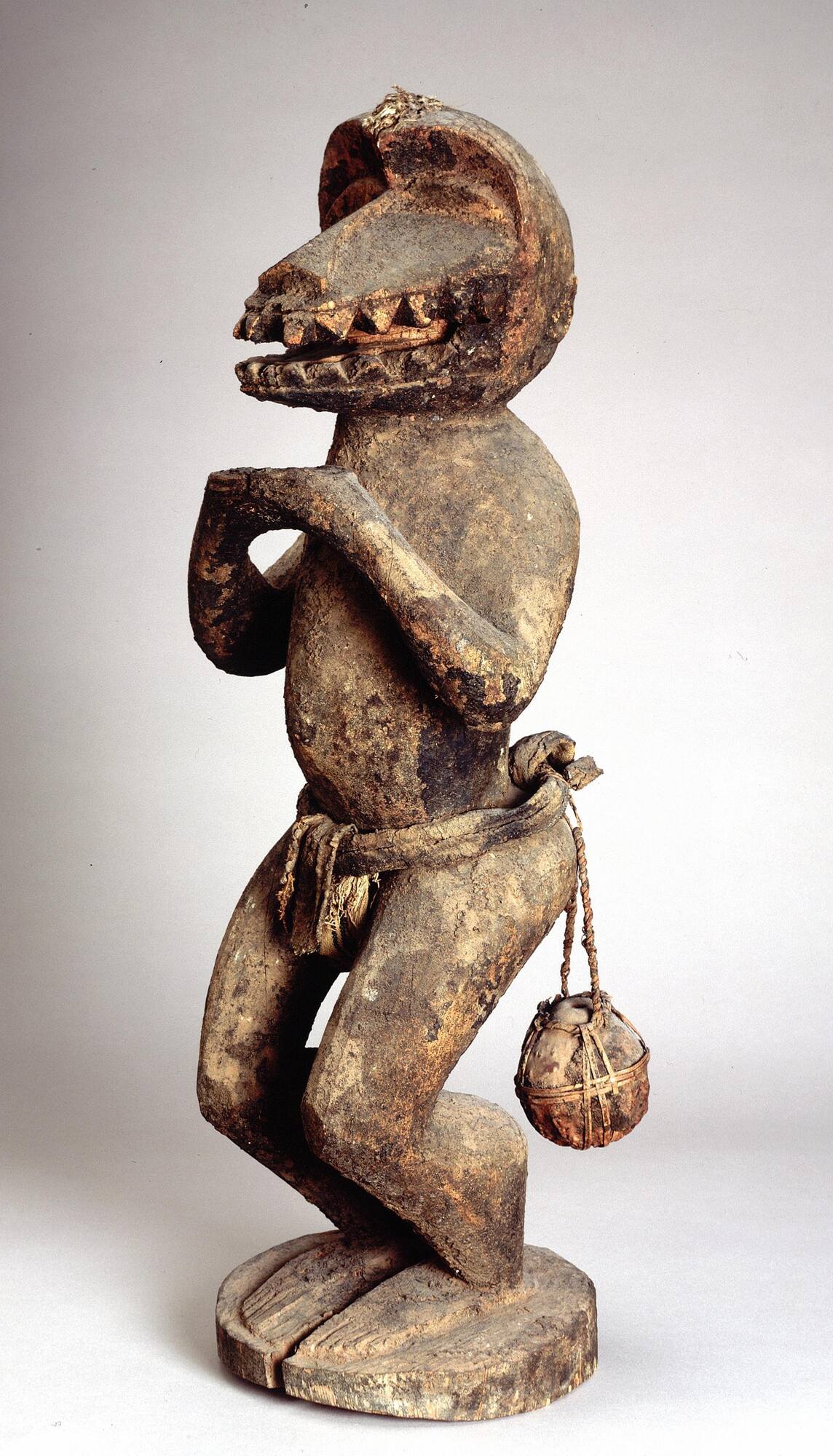
BRIEF DESCRIPTIONThis baboon was made to stand guard at the gate of a Baule village and, if properly(…)
BRIEF DESCRIPTIONThis baboon was made to stand guard at the gate of a Baule village and, if properly venerated, to ensure the protection and fertility of farmers’ crops.WHERE WAS IT MADE?This was made in the Ivory Coast, in a Baule community.HOW WAS IT MADE?This figure was carved from a piece of camwood, a type of tree commonly found in Africa.HOW WAS IT USED?According to Baule mythology, the baboon and other ape figures symbolize the son of the god of heaven. This rough-hewn ape would have stood at a village gate, serving both as guardian of the community and patron of farmers. Offerings are given to this figure to ensure both the safety of a farmer’s crops and an abundant harvest.WHY DOES IT LOOK LIKE THIS?Notice the outstretched hands of the baboon; they are poised to receive gifts. These offerings usually come in the form of yams, the staple crop for the Baule. The surface texture is an encrustation of food and drink – another form of offering that is poured over the figure._________________________________________________________________________The gbekre or baboon figures are popular among the Baule people of the Ivory Coast, an Akan group, speaking a Twi language of the Kwa branch of the Niger-Congo family. The function of the gbekre figures is understood in terms of the centrality of agriculture in Baule life demonstrated in the annual harvest festival in rural areas, in which the first yam, the major staple food, is symbolically offered to the ancestors. Gbekre are placed as guardians at the gates of villages, but they are also considered the patron of the farmers. According to Baule mythology, the baboon and other ape figures symbolize the son of the god of heaven. It receives the offerings for this deity to ensure the protection and fertility of the farmersÕ crops. The Baule use of the baboon figure can be attributed to the apes’ closeness to humankind, alluding to a higher, spiritual being. Carved in natural unstained wood with minimal details and projecting jaws, the gbekre figures are in contrast to the smooth and shiny surfaces, intricate stylization, meticulous attention to anatomical description, and coiffure and body decoration considered to be characteristic of traditional Baule sculpture. Gbekre figures are often portrayed with open hands or holding small cups for sacrificial offerings; their surfaces are often encrusted with the sacrifices poured directly over them. (From “A Handbook of the Collection: Herbert F. Johnson Museum of Art,” 1998)