

Object Details
Culture
Maasai (Kenya)
Medium
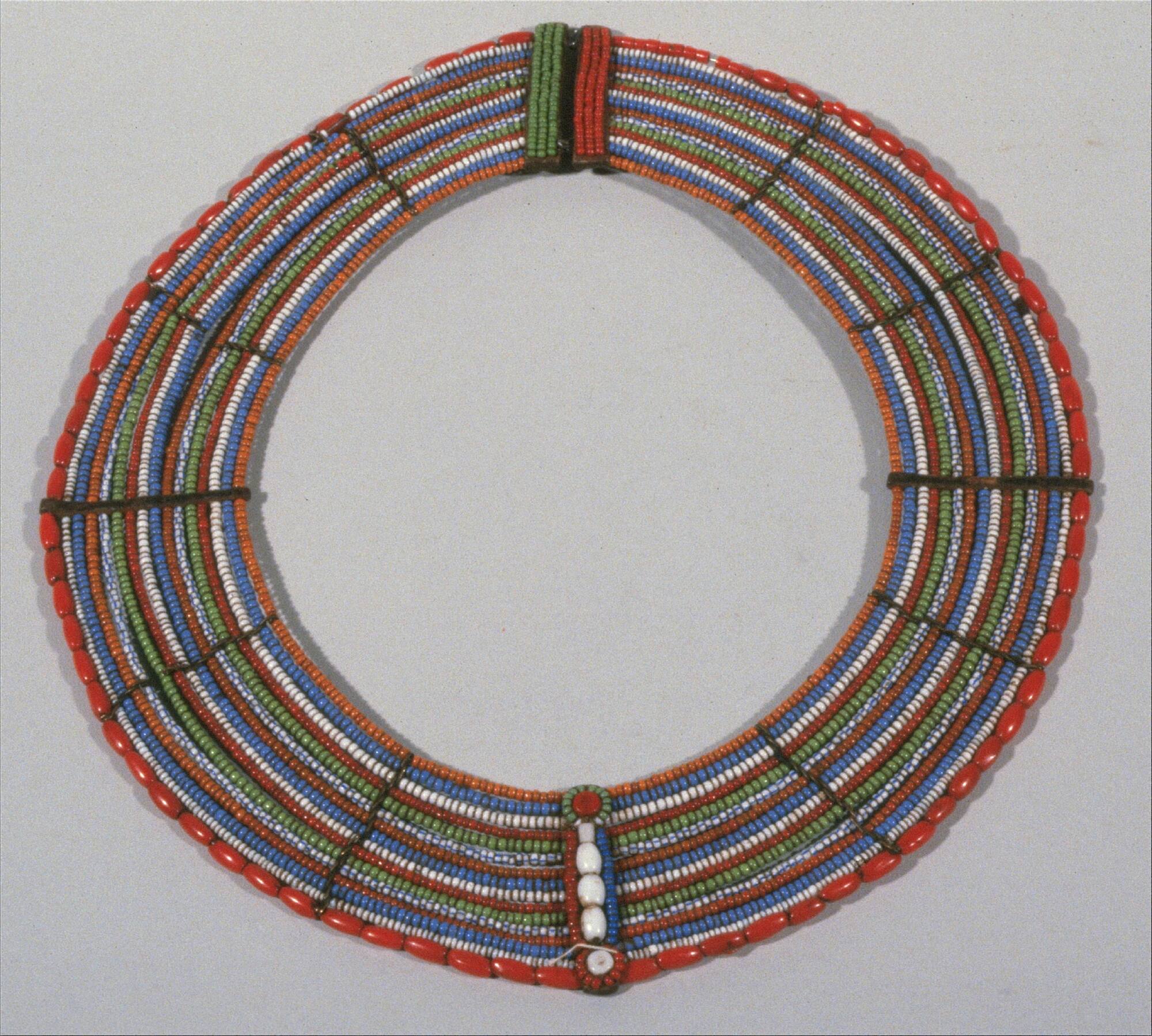
Multi-colored glass beads on wire, with leather clasps
Dimensions
Diameter: 9 inches (22.9 cm)
Credit Line
Gift of Sarita Hopkins Weeks, in memory of her mother, Sara Sessions Hopkins
Object
Number
81.040.008
BRIEF DESCRIPTIONThis Maasai necklace is a bride ornament, made with beads purchased by the bride’(…)
BRIEF DESCRIPTIONThis Maasai necklace is a bride ornament, made with beads purchased by the bride’s family and assembled by women in the community.WHERE WAS IT MADE?The Maasai are a nomadic people who travel with their cattle herds in parts of Kenya and Tanzania. HOW WAS IT MADE?Among the Maasai, women are associated with creative endeavors such as childbirth and home building, and therefore they make all beadwork. Women take great pride in producing fine, careful work. This necklace was made by a group of Maasai women and girls as a gift for a bride-to-be. A bride who wears many necklaces not only exhibits considerable familial wealth, she also bears signs of communal favor and the efforts extended on her behalf. Notice that the necklace has a leather clasp. It is thought that the Maasai began adding clasps to their necklaces when tourists began asking to purchase these necklaces right off of women’s necks.HOW WAS IT USED?This specific necklace was most likely among a sequence of necklaces layered on top of each other gaining width towards the collarbone. Due to its size, this necklace would have been somewhere in the middle of the layers. The smallest necklace, closest to the chin, might have five to seven rings. The largest might have more than 30 rings, and is sometimes called the bull necklace (because the family of the bride might have to sell a bull to purchase enough beads to complete it.)Beadwork is a Maasai woman’s personal wealth, comparable in many ways to a man’s cattle.WHY DOES IT LOOK LIKE THIS?The round glass beads, called “seed beads,” were originally imported from major European trading centers in the early 20th century. The colors of older East African beads were limited to white, black, navy, royal and pale blue, red, and scarlet. This necklace was probably made after WWII (1945) when European production of beads resumed in better quality and in a more diverse set of colors, such as yellow, orange, several shades of green, and clear.Just as people of European descent place colors into categories such as primary vs. secondary, or warm vs. cool, Maasai jewelers group colors into two categories that heighten contrast. Strong colors (red, blue, and black) are never placed beside each other. According to Maasai aesthetic notions, strong colors must be broken up with weak colors (orange, green, yellow, and white). A popular quintet of the colors red, green, white, orange and blue represents the colors of the rainbow as the Maasai see it. Notice that these are the colors present in this necklace. In this quintet, strong and weak colors are paired together (orange with blue, red with green) and are separated by white.Before the importation of glass beads, women’s necklaces were made of heavy iron, copper and brass wire shaped by blacksmiths and worn in a spiral-like adornment.Emma Osore ‘09, contributed to this entry.