



Object Details
Culture
Benin (Nigeria)
Date
20th century
Medium
Cast metal
Dimensions
6 1/4 x 2 3/4 inches (15.9 x 7 cm)
Credit Line
Gift of Sarita Hopkins Weeks, in memory of her mother, Sara Sessions Hopkins
Object
Number
81.040.005
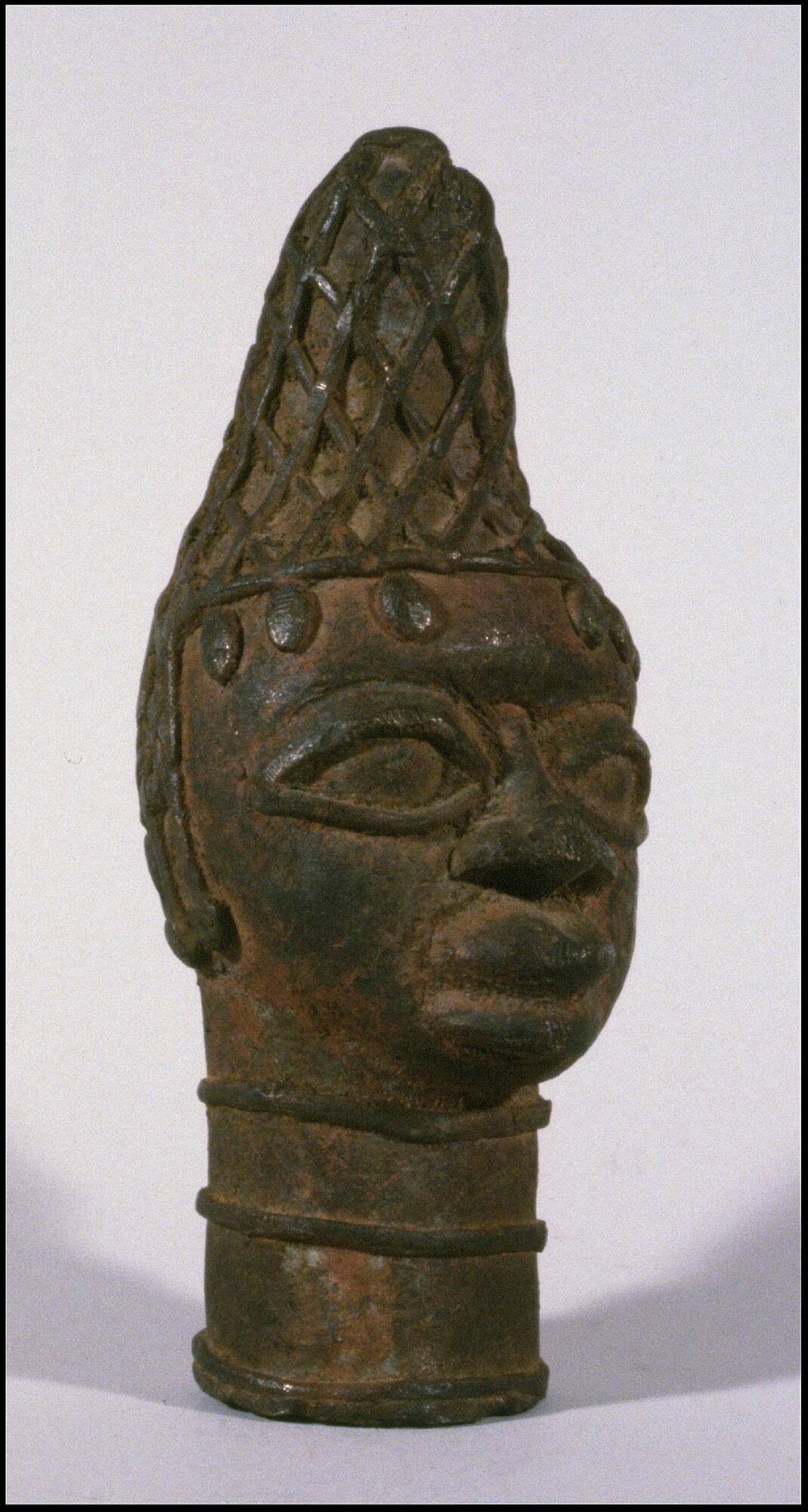
BRIEF DESCRIPTIONThis is a commemorative head for the Queen Mother, a senior chief of the king’s c(…)
BRIEF DESCRIPTIONThis is a commemorative head for the Queen Mother, a senior chief of the king’s court in the historic kingdom of Benin. WHERE WAS IT MADE?This casting was made in Nigeria, in an area that was once the kingdom of Benin (not to be confused with the present-day country of Benin.) The great kingdom of Benin, with whom the Portuguese, Dutch, and British traded, came to an end in 1897. A series of misunderstandings and overreactions on the part of both the Benin court and the British government resulted in a punitive expedition. This act of British aggression ended with the deaths of many Benin people, the imprisonment of the Oba (the king), and the widespread looting of the riches of the Benin kingdom. The office of the Oba was restored in 1914, but only under British colonial rule.HOW WAS IT MADE?This head does not adequately represent the fine craftsmanship exhibited by Benin artists prior to colonial rule. Metalwork in the Benin kingdom began as early as the 16th century. Called “bronzes” by Europeans, but actually made of brass, the material was favored by the Benin court for its longevity. An Edo proverb states: “Brass never rusts, lead never rots.” Although “bronzes” have continued to be made in the 20th century using the traditional lost-wax casting technique, recent pieces tend to be smaller and less refined than those made between the 17th and the 19th centuries. Benin artists fashion a variety of objects using the lost wax method – a process that results in only one cast object, each a unique work. The artist makes a form out of softened wax, covers the form with slip and clay, and finally heats the covered form in order to melt the wax and replace it with molten brass. After the cast object cools, it is cleaned – leaving no mold to use again. HOW WAS IT USED?Benin artists began producing Queen Mother commemorative heads as early as the sixteenth century when the kingdom accepted the marginal participation of the Queen Mother in court. She was not permitted to be in the presence of the king (Oba), but functioned from her distant compound as a senior chief. The commemorative head is placed on an altar that honors deceased Obas. WHY DOES IT LOOK LIKE THIS?Facial features on the Queen Mother heads are not individualized; the elliptical eyes, broad nose, and sharply delineated lips are highly stylized and conventional in Benin art. Notice the conical coiffure; it is called a chicken’s beak, and may be worn only by the Queen Mother or the wives of the Oba. Notice the crisscross pattern on its surface—this is a net made from coral beads. Although the Oba may also wear coral, it has special significance for the Queen Mother. The deep orange material is associated with the god Olukun, “owner of the sea” and protector of women’s fertility and productivity.