

Object Details
Culture
Kota-Obamba (Gabon)
Date
late 19th century-early 20th century
Medium
Wood and brass
Dimensions
Height: 20 inches (50.8 cm)
Credit Line
Bequest of Hilda Brand Jaffee
Object
Number
81.012.011
81.012.011, Reliquary guardian figure (Mbulu-Ngulu), GabonBRIEF DESCRIPTIONThis Gabon sculpture had (…)
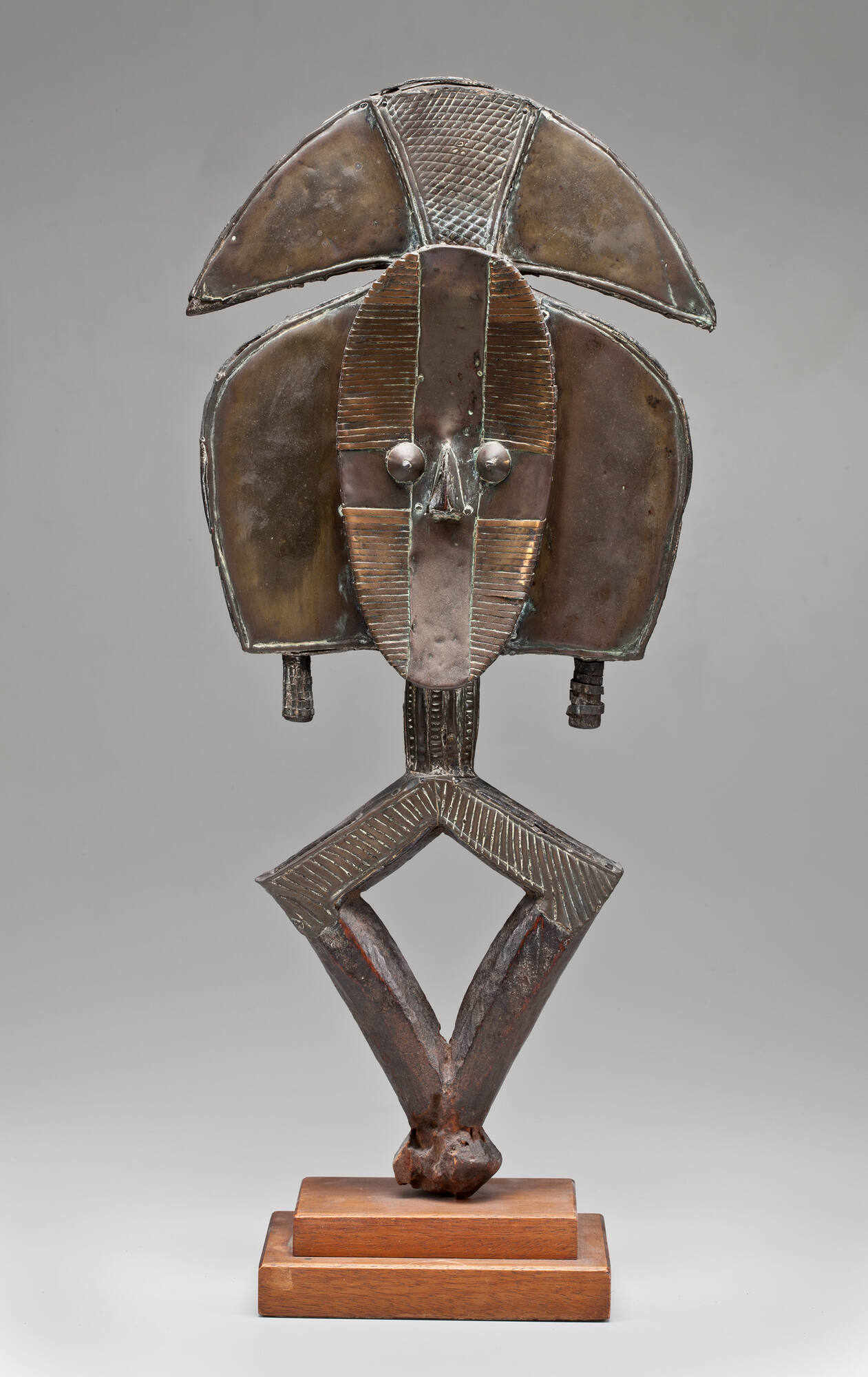
81.012.011, Reliquary guardian figure (Mbulu-Ngulu), GabonBRIEF DESCRIPTIONThis Gabon sculpture had an important spiritual function. Reliquary figures like this one were mounted on containers holding bones and relics of an important clan ancestor, serving as guardians.WHERE WAS IT MADE?The Kota are a Bantu ethnic group that occupy the Ogouee-Ivindo province in northeastern Gabon. Some families live in neighboring Congo-Brazzaville, and related groups such as the Batanga are also found in Cameroon. HOW WAS IT MADE?The artist first carved the figure in wood, and then covered it with sheets of brass. Look at the patterned areas of the figure; these were created by repoussé. The metal sheets were attached to the sculpture with nails. The preciousness of the metal reflects the important sacred function of the object.HOW WAS IT USED?In its original context, the figure would have been fitted to the top of a woven raffia ossuary basket containing the skulls and bones of ancestors, as well as medicines and significant objects. These portable reliquaries allowed the semi-nomadic Kota peoples of the past to transport their revered forbearers. An ossuary with its attached guardian figure was either left in the open outside the village or placed alongside others in a communal sanctuary. Initiated male members of the community consulted their ancestor’s spirits before major events and honored them in festive ceremonies. Due to Christian missionary activity and local conversion at the turn of the twentieth century, Kota peoples have ceased to venerate their ancestors with reliquaries and their attendant guardian figures.WHY DOES IT LOOK LIKE THIS?Notice the highly stylized and flattened abstract forms of the head, neck, and arms. Designs around the head represent an elaborate coiffure, and the diamond shape below the neck represents the body. The exposed wood portion of the base of this object would not have been seen when attached to its reliquary. Although the Kota-Obamba peoples are not believed to have danced the figure – holding it like a wand as did their neighbors, the Kota-Mahongwe – signs of wear on this base suggests that the Kota-Obamba may have danced their figures as well._________________________________________________________________________This figure (also known as a Bwete or Biwiti figure) is typical of the relic statuary of the Kota and Mahongwe people who live mainly in the east of Gabon and to a lesser extent in the Congo, where the Mahongwe also live. Such figures are used as guardians for relic containers where the skulls and bones of revered and prominent ancestors are kept. The containers, normally wickerwork baskets or bark barrels, are part of family or village shrines called Biwitii. The guardian figure was expected to work for the benefit of the owner or the community. The same figures are also used as a dance mask when attached to a raffia disguise during the annual Biwiti rites. The guardian figure’s lower end is normally stuck into the relic container. The head rests on a cylindrical neck with its lower part split to form the lozenge-shaped base, hypothesized to be a stylized representation of the arms. The front part of the figure is covered with brass and copper sheets or strips, and with iron sheets applied to create an aesthetically pleasing color contrast. The use of metals such as copper or brass, considered expensive, is probably meant to display wealth as well as to honor the ancestors or to ward off the evil spirits at night. Their shining and brilliant surfaces recall daylight, which is considered anathema to the presence of evil spirits. (From “A Handbook of the Collection: Herbert F. Johnson Museum of Art,” 1998)