


Above the Morgan Japanese Garden
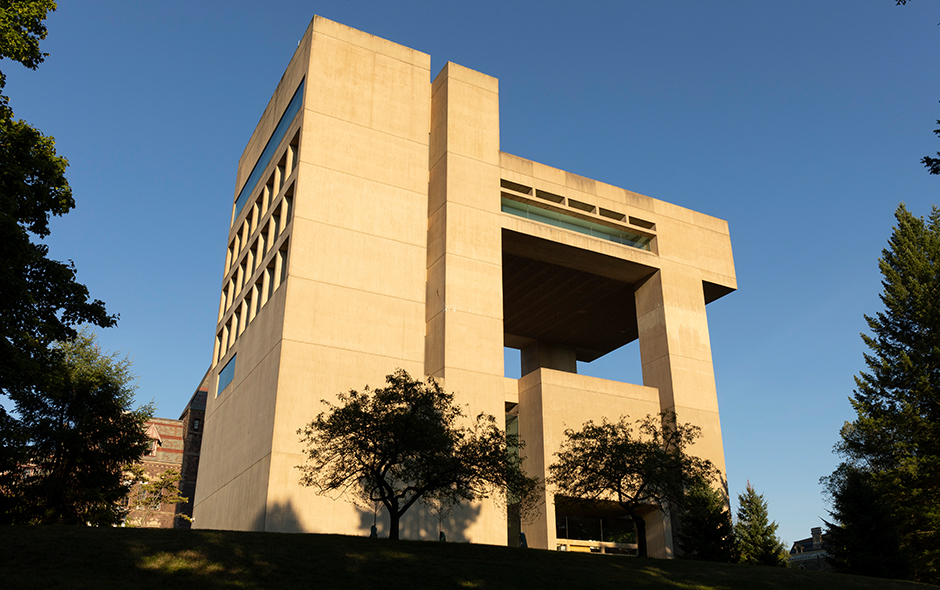
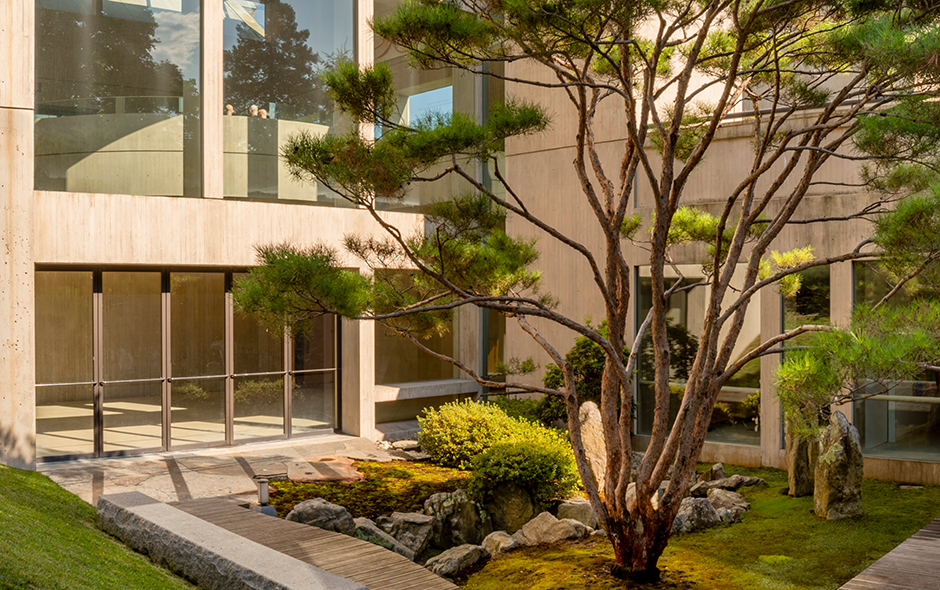
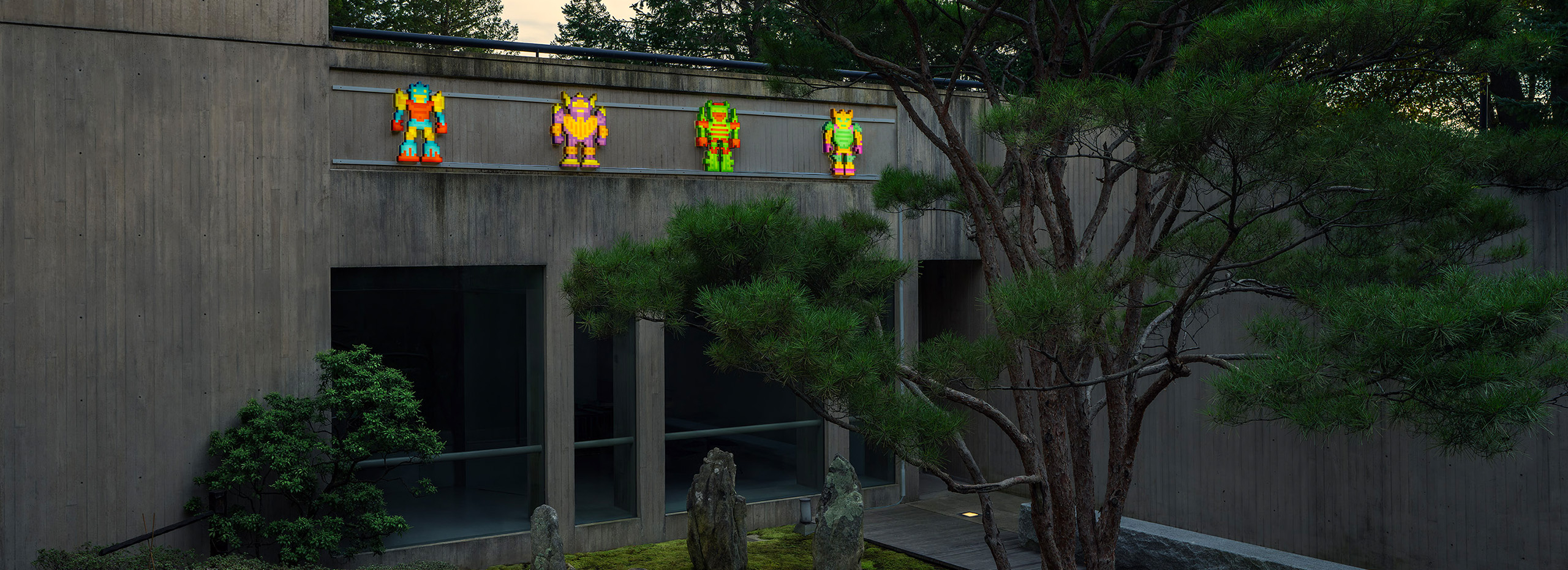
Garden Invaders is a playful homage to Japanese aesthetics, past and present. It consists of four backlit sculptures placed on an outside wall above the Johnson Museum’s Morgan Garden. The original Museum building was designed by I. M. Pei in 1973; brutalist concrete walls harmoniously surround the 2011 courtyard garden on the Museum’s north side. The space exemplifies the precision, serenity, and balanced aesthetics that characterize traditional Japanese gardens.
The sculptures are shaped like extruded pixelated alien figures, inspired by early digital graphics. Their front surfaces are visibly divided into blocks of flat, square color, illuminated from within. The sides of each sculpture are shaped to match this pixelation. The sculptures are installed above a large glass window, on a concrete architectural recess that invites placement of the artwork as a sculptural relief.
Their elevated placement evokes a postapocalyptic alien descent into the garden, reminiscent of early computer games. This aesthetic also recalls influential Japanese kaiju super-creatures and biomorphic invaders from the postwar era into the present. Partly developed as a response to Hiroshima, Nagasaki, and the release of uncontrolled destructive forces, this visuality evokes both fascination and fear of a technologized but uncharted future.
Today, we are witnessing a world where militaristic colonialism has returned with renewed force, concern for the environment has been displaced by an aggressive extractive mentality, and physical and sensory interaction with nature is increasingly supplanted by digitally rendered and AI-generated worlds. The aesthetic tension between the serenity of the garden and the alien figures’ machinelike, computerized artifice also allegorizes contemporary geopolitical tensions, a growing indifference toward ecological harm, and the colonization of our consciousness by synthetic creations.
The artists would like to thank Ellen Avril, interim director and the Judith H. Stoikov Curator of Asian Art, for her curatorial guidance, as well as William Woodams, Matt Conway, Valerie Kane, and Annie Abernathy for their collaboration and assistance at the Museum.
This exhibition was supported in part by the Ames Exhibition Endowment.
Iftikhar Dadi (born in Karachi; lives and works in Ithaca) and Elizabeth Dadi (born in Seattle; lives and works in Ithaca), Garden Invaders, 2026. LED lights and mixed media; site-specific installation. Overall: 36.75 × 268 × 5 inches. Courtesy of the artists. (Image courtesy of the artists.)