


In the Opatrny Gallery, Floor 2L
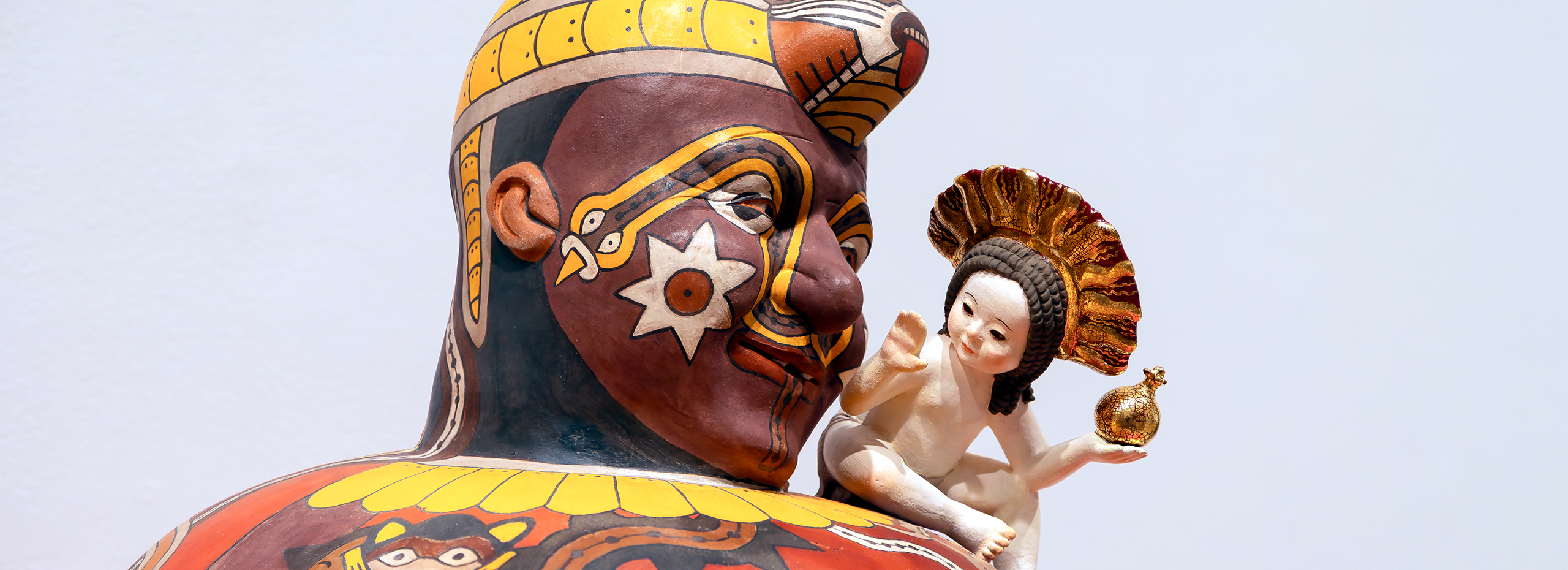
The annual celebration of Corpus Christi in Cusco, Peru, inspired artist Kukuli Velarde (born 1962 in Lima, Peru) to create the series Corpus. In each of the series’ fifteen sculptures, Velarde draws on visual codes from ancient and contemporary Indigenous civilizations to critique the idea of universal aesthetics, one that is actually shaped by European canons of beauty and imposed by centuries of oppression.
During the sixteenth century, the Spanish replaced Andean religious celebrations and local divinized entities with the Corpus Christi celebration and figures of the Catholic pantheon. This festival, then, was seen as the triumph of Christ over death, as the domination over the Indigenous population who, during the viceregal era, participated in the procession with recognizable ethnic garments.
The figures at Cusco’s Corpus Christi Feast, however, hide something else. In a revelatory moment, Velarde’s mother witnessed a large rock being attached to the float carrying San Cristóbal. That rock could be a powerful animate entity of Andean cosmology, a huaca. Velarde’s sculpture San Cristobal, with its aesthetic drawn from the ancient Nasca style, is a visual representation of syncretism but also reveals the unseen other disguised as the Christian saint. This piece, like Peruvian society today, is a powerful testament to the subalterns’ resistance to cultural, aesthetic, and religious impositions.
This exhibition was curated by Hugo C. Ikehara-Tsukayama, Harris Family Curator of the Arts of the Americas, and supported in part by the Russell ’77 and Diana Hawkins Exhibition Fund.